Chinese Humanoid Robot "Lightning" Shatters Human Half-Marathon Record: From 2 Hours 40 Minutes to 50 Minutes in Just One Year
Beijing, April 19, 2026 – In a scene straight out of science fiction that has now become reality, the humanoid robot named "Lightning" (Leiting Shandian), developed by Chinese smartphone maker Honor, crossed the finish line of the 21.1 km half-marathon in just 50 minutes and 26 seconds. This performance not only outperformed all 12,000 human runners participating in the parallel event but also shattered the men's half-marathon world record of 57 minutes 20 seconds set by Ugandan runner Jacob Kiplimo in Lisbon just over a month earlier.
Chinese Humanoid Robot "Lightning" Shatters Human Half-Marathon Record: From 2 Hours 40 Minutes to 50 Minutes in Just One Year
Beijing, April 19, 2026 – In a scene straight out of science fiction that has now become reality, the humanoid robot named "Lightning" (Leiting Shandian), developed by Chinese smartphone maker Honor, crossed the finish line of the 21.1 km half-marathon in just 50 minutes and 26 seconds. This performance not only outperformed all 12,000 human runners participating in the parallel event but also shattered the men's half-marathon world record of 57 minutes 20 seconds set by Ugandan runner Jacob Kiplimo in Lisbon just over a month earlier.
This marked the second edition of the Beijing E-Town Humanoid Robot Half-Marathon, held in the Yizhuang Economic-Technological Development Area (E-Town). The event served not merely as a sporting competition but as the largest real-world "field test" yet for China's rapidly advancing humanoid robot technology.
Event Background and Scale
The race began at 7:30 a.m. on April 19, 2026, along Kechuang 17th Street in E-Town. More than 300 humanoid robots from 112 teams (including 5 international teams from Germany, France, Brazil, and others) took part — a significant increase from around 21 robots the previous year. Approximately 40% of the robots competed in the fully autonomous navigation category, relying on sensors, AI, and algorithms for self-orientation and obstacle avoidance, while the rest were remotely controlled with a 1.2x time adjustment coefficient applied to their results.
Robots and humans ran on parallel lanes, separated by barriers and greenery to prevent collisions. Spectators lined the route, cheering enthusiastically, while live streams attracted hundreds of millions of views. Many families brought children to witness robots "running faster than people."
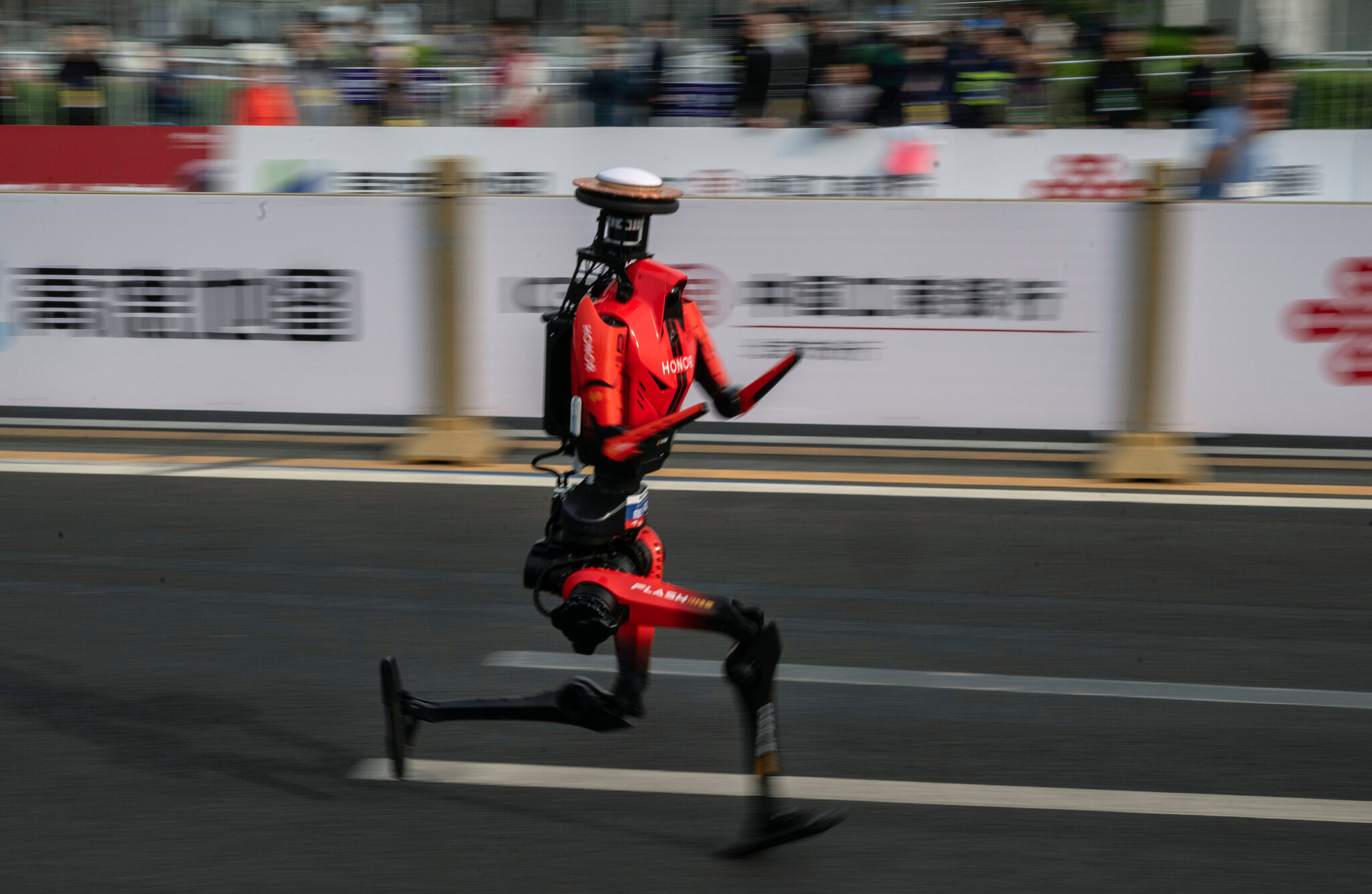
Image: Honor's red "Lightning" robot sprinting at high speed on the track, with spectators in the background.
Historic Victory for "Lightning" and Honor's Team
The champion robot, Lightning (also referred to as Robotics D1), belonged to Honor's Qitian Dasheng (Monkey King) team. It completed the course at an average speed of approximately 25 km/h — an astonishing figure for a bipedal robot.
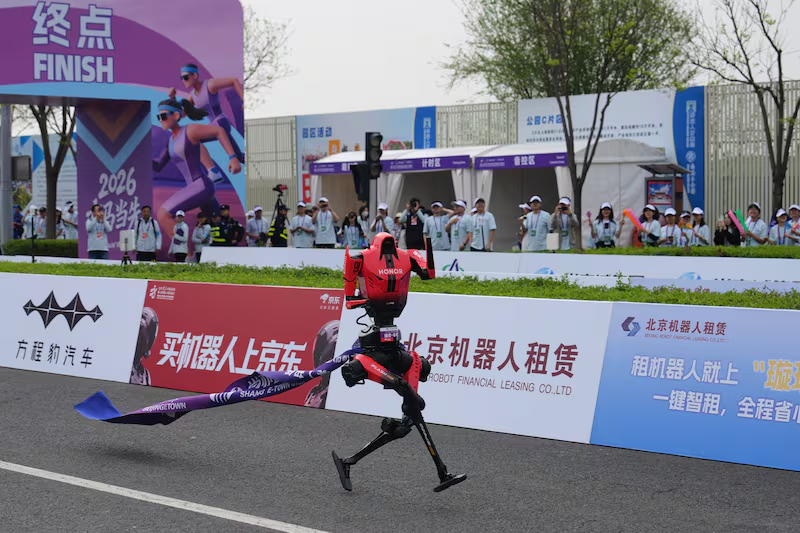
Notably, just meters before the finish line, Lightning collided with a barrier and fell. With quick assistance from support staff, it stood up, readjusted its posture, and crossed the finish line. Its official net time remained 50 minutes 26 seconds — nearly 7 minutes faster than the human world record.
The next two positions were also swept by Honor's Lightning variants: second place in 50 minutes 56 seconds and third in 53 minutes 1 second. All three podium finishers competed in the autonomous navigation category, demonstrating Honor's dominance.
Image: Lightning crossing the finish line with a ribbon banner flying, surrounded by spectators and organizers.
The fastest human runner, Zhao Haijie, finished in 1 hour 7 minutes 47 seconds. He commented: “They were incredibly fast — they just zoomed past me right from the early kilometers.”
Remarkable Progress in One Year
In the 2025 inaugural event, the race was largely a "disaster" for the robots: many fell at the starting line, veered off course, or simply stopped. Only 6 out of 21 robots completed the distance. The winner, Tiangong Ultra, took 2 hours 40 minutes 42 seconds — far slower than human competitors.
By 2026, the situation had transformed dramatically. Participation surged, failures decreased sharply, and multiple robots finished under 1 hour. At least four robots completed the race in less than 60 minutes. Spectator Sun Zhigang remarked: “I can feel the enormous change. This is the first time robots have surpassed humans — something I never imagined.”
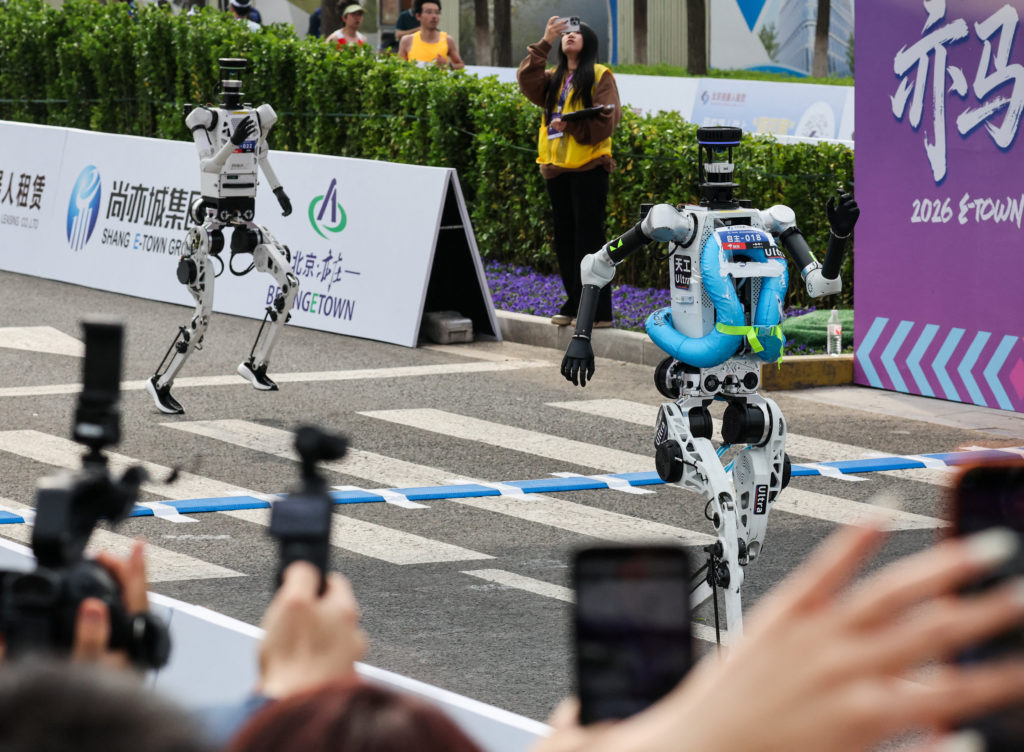
Image: Group of white and blue humanoid robots running on the course, with spectators and photographers ahead.
Image: A black robot running alongside human athletes, while spectators cheer and film with their phones.
Technology Behind the Success
Lightning stands approximately 1.65–1.70 meters tall, with leg lengths of 90–95 cm to mimic the stride of elite human runners. It incorporates liquid cooling technology — adapted from Honor's smartphone expertise — to maintain high performance over extended periods without overheating.
Key improvements included:
Motors and joints: Enhanced speed, precision, and torque.
Sensors and AI: Multi-sensor fusion (vision, LiDAR, IMU) for balance, terrain recognition, and obstacle avoidance.
Gait algorithms: Trained on large-scale simulation data to produce natural, human-like running motion.
Power and structure: More durable batteries and frames capable of withstanding impacts.
Ma Huaze, captain of Honor's team, shared: “The biggest challenge was daring to implement major upgrades on such a competitive real-world stage. We were very nervous.”
Du Xiaodi, an engineer from the winning team, emphasized: “Running fast is not just a sports goal — it transfers technology to structural reliability, thermal management, and future industrial applications.”
Broader Significance
The event vividly illustrates China's ambition to lead in humanoid robotics. The country boasts over 150 companies and laboratories focused on humanoid robots, backed by strong government policies, subsidies, and national plans for 2026–2030 emphasizing AI, brain-like chips, quantum computing, and automated factories.
Experts note that future humanoid robots could replace humans in dangerous jobs, elderly care, power grid maintenance, or work in harsh environments. However, limitations remain: “Today’s robots have the body of Mike Tyson but still lack the brain of Stephen Hawking. Once the ‘brain’ problem is solved, the potential will be limitless,” said an engineer from Intercity Technology.
In Vietnam, the news received widespread attention. Outlets like VnExpress and Tuổi Trẻ quickly reported on the "astonishing" one-year leap and its potential applications in manufacturing and logistics.
Challenges and the Road Ahead
Despite the major success, incidents still occurred: one robot fell face-first about 60 meters after the start and required temporary tape repairs; another veered into bushes after finishing. Support teams followed on golf carts, ready to assist.
In the long term, developers stated they are not competing against humans but “against their own version from last year.” Future goals include greater durability, lower production costs, and more advanced AI for handling complex real-world scenarios.
Jacob Kiplimo, the human world record holder, had not issued an official response at the time, but the sports and tech communities were abuzz about the blurring line between humans and machines.
Conclusion: A New Era?
The 2026 Beijing E-Town Humanoid Robot Half-Marathon was more than a sporting event — it represented a historic milestone in the journey toward advanced artificial intelligence and robotics. From the stumbling steps of last year to "flying" across the course faster than any human in just 12 months, it stands as living proof of the explosive pace of technological development in China.
As Lightning stood on the victory podium — sweat-free and tireless — many wondered how the future of labor, sports, and daily life would change. The answer likely lies in those increasingly fast and steady metallic footsteps on humanity’s racetrack.
(This article is based on reports from CNN, The Guardian, NBC News, AP News, Reuters, Global Times, China Daily, VnExpress, Tuổi Trẻ, and event footage/photos)