The Formation of the Sun: How Our Solar System Came to Be
The Formation of the Sun: How Our Solar System Came to Be
The story of how our Solar System formed is an extraordinary journey spanning billions of years. From a massive cloud of gas and dust drifting through space, a complex system emerged—one that includes the Sun, eight planets, moons, asteroids, comets, and countless other celestial bodies. Understanding this process gives us insight not only into our own cosmic origins but also into how planetary systems may form throughout the universe.
1. The Solar Nebula: Where It All Began
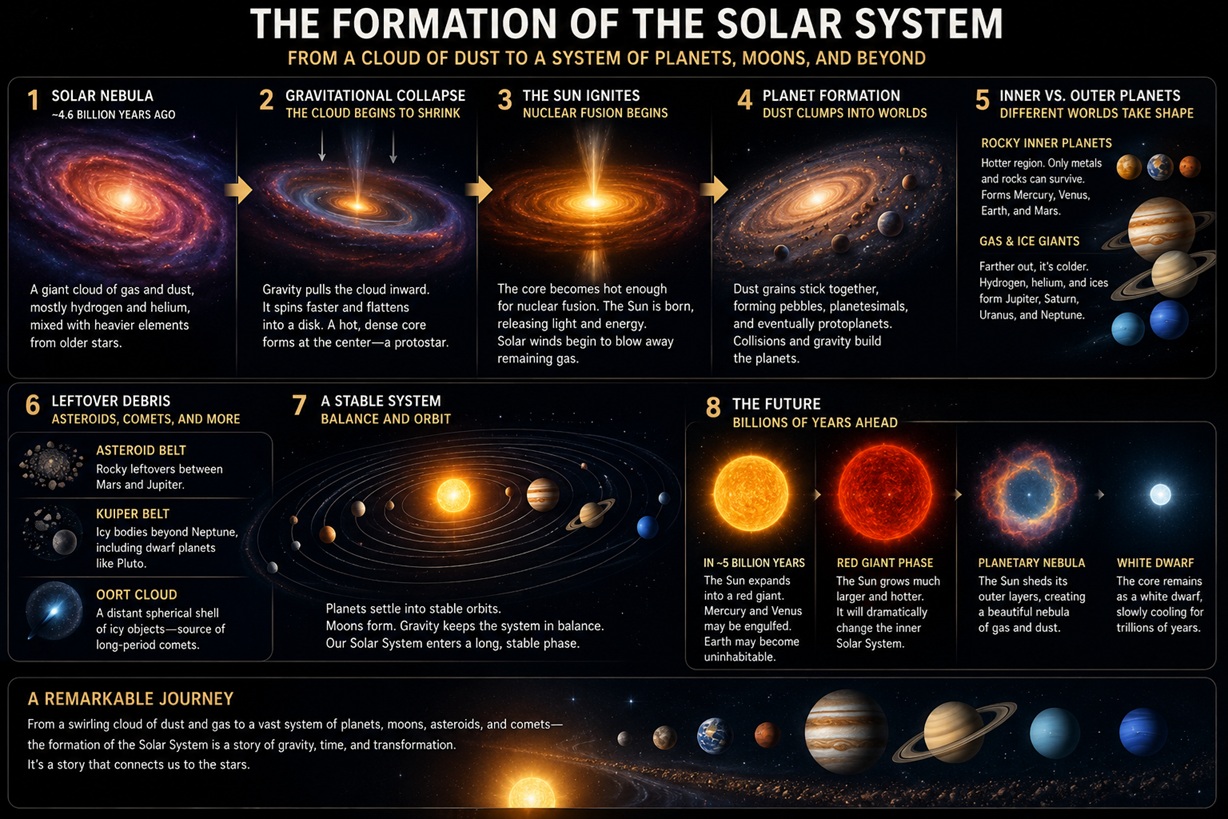
About 4.6 billion years ago, our Solar System began as a giant cloud of gas and dust known as the solar nebula. This nebula was primarily composed of hydrogen and helium—the most abundant elements in the universe—along with heavier elements forged by previous generations of stars.
These heavier elements were created through nuclear fusion inside stars and scattered across space by supernova explosions. Over time, gravity pulled this material together into dense molecular clouds, setting the stage for the birth of a new star system.
2. Gravitational Collapse: The Birth of a Protostar
At some point, a nearby disturbance—possibly the shockwave from a supernova—triggered the collapse of part of the solar nebula.
As gravity pulled the cloud inward:
The material began to compress
The cloud spun faster due to conservation of angular momentum
The rotating mass flattened into a spinning disk
At the center of this disk, pressure and temperature rose dramatically, forming a protostar—the early stage of what would become our Sun.
3. The Sun Ignites
As the protostar grew denser and hotter, temperatures in its core eventually became extreme enough to trigger nuclear fusion.
Hydrogen atoms fused into helium, releasing tremendous amounts of energy in the form of light and heat.
This marked the true birth of the Sun.
Once fusion began:
The Sun became a stable main-sequence star
Solar winds pushed lighter gases outward
The surrounding disk continued evolving into planets and smaller objects
The Sun’s formation was the defining event that shaped the entire Solar System.
4. Planet Formation: Building Worlds
The remaining gas and dust in the protoplanetary disk began clumping together through collisions and gravity.
Step-by-step process:
Dust Grains
Tiny particles stuck together through electrostatic forces.
Planetesimals
Over time, these particles formed larger rocky bodies, often several miles wide.
Protoplanets
Repeated collisions created planet-sized bodies.
Full Planets
After millions of years, these objects became the planets we recognize today.
5. Inner vs. Outer Planets
Rocky Inner Planets
Closer to the Sun, temperatures were too high for volatile gases to condense.
This region formed the terrestrial planets:
Mercury
Venus
Earth
Mars
These planets are composed mainly of:
Iron
Nickel
Silicate rock
Gas Giants and Ice Giants
Farther from the Sun, cooler temperatures allowed gases and ices to accumulate.
This led to the formation of:
Jupiter
Saturn
Uranus
Neptune
These massive planets developed:
Dense cores
Thick atmospheres rich in hydrogen and helium
Extensive moon systems
6. Leftover Debris: Asteroids and Comets
Not all material became planets.
Asteroid Belt
Between Mars and Jupiter lies a vast region of rocky debris known as the asteroid belt.
Kuiper Belt
Beyond Neptune lies a region of icy bodies, including dwarf planets like Pluto.
Oort Cloud
Farther still, the Solar System is thought to be surrounded by a spherical shell of icy objects that can become long-period comets.
These remnants are valuable records of the Solar System’s early history.
7. Long-Term Stability
Once major formation ended, the Solar System entered a relatively stable phase.
Today:
Planets orbit the Sun in predictable paths
Moons orbit planets
Gravity maintains balance across the system
While collisions and orbital shifts still occur, the overall structure has remained stable for billions of years.
8. The Future of the Solar System
The Sun is currently about halfway through its life.
In about 5 billion years:
Hydrogen in the Sun’s core will run out
The Sun will expand into a red giant
Mercury and Venus may be engulfed
Earth could become uninhabitable
Eventually:
The Sun will shed its outer layers
A planetary nebula will form
The remaining core will become a white dwarf
Over trillions of years, that white dwarf will gradually cool and fade.
Conclusion
The formation of the Solar System is one of the universe’s most remarkable stories—a transformation from a swirling cloud of gas and dust into a dynamic system capable of supporting life.
From the birth of the Sun to the formation of planets and the evolution of cosmic debris, this process reveals the incredible power of gravity, time, and physics.
By studying our Solar System’s origins, scientists gain a deeper understanding of:
Planetary formation
Stellar evolution
The possibility of life in other star systems
Our Solar System is not just our home—it is a window into the broader workings of the cosmos.