Titan – The "Second Earth" That Took Our Breath Away Just Got a Devastating Verdict: It Might Be Completely Lifeless
Titan – The "Second Earth" That Took Our Breath Away Just Got a Devastating Verdict: It Might Be Completely Lifeless
Imagine standing on a distant world beneath a thick, hazy orange sky. In front of you stretch vast rivers snaking across the landscape, shimmering lakes, towering mountains, and endless organic dunes — a world that looks strikingly like Earth. This is Titan, Saturn’s largest moon, long described by NASA as “another Earth.” But a groundbreaking new study just published in the journal Astrobiology has delivered a shocking blow: this “Second Earth” may be uninhabitable.
Led by planetary scientist Catherine Neish from Western University (Canada), the research concludes that Titan’s hidden subsurface ocean — once considered a promising cradle for alien life — likely lacks the essential organic building blocks needed for life to emerge. This finding directly contradicts decades of optimistic NASA assessments that placed Titan at the very top of the list for missions hunting extraterrestrial life, alongside Enceladus and Europa.
A World That Looks Too Much Like Home
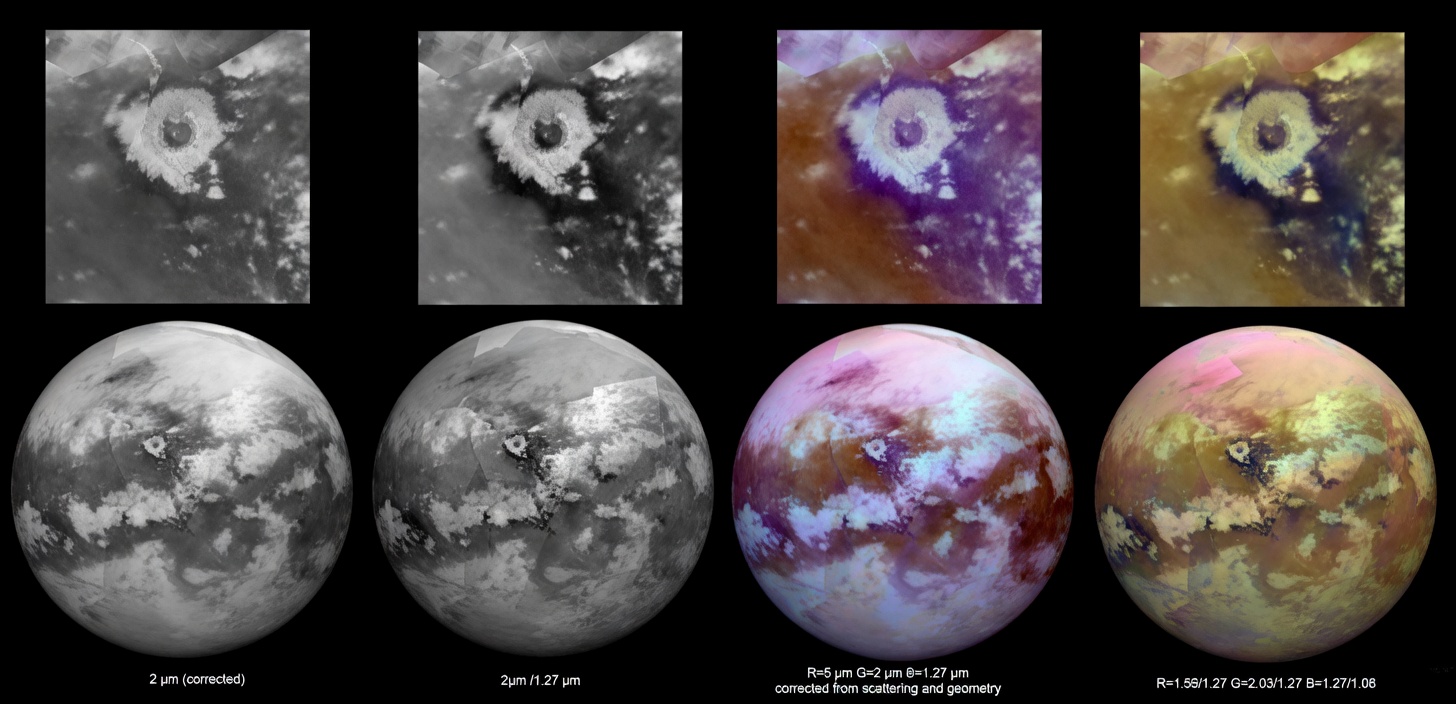
Titan is enormous — larger than the planet Mercury, with a diameter of 5,150 km. Its atmosphere is 1.5 times thicker than Earth’s, composed mostly of nitrogen and methane, creating a dense orange smog that completely hides the surface. Beneath that veil lies one of the most Earth-like landscapes in the entire Solar System.
It has:
Rivers (of liquid methane)
Lakes and seas (the largest, Kraken Mare, is bigger than the Caspian Sea)
Mountains made of water ice rising thousands of meters high
Organic sand dunes stretching hundreds of meters tall
Rain, clouds, and a complete methane hydrological cycle
In 2005, the European Space Agency’s Huygens probe (part of the joint NASA-ESA Cassini-Huygens mission) successfully landed on Titan’s surface — the first landing on a moon other than our own. It sent back haunting images: pebble-strewn plains, river channels, and a surface that looked eerily like a prehistoric Earth.
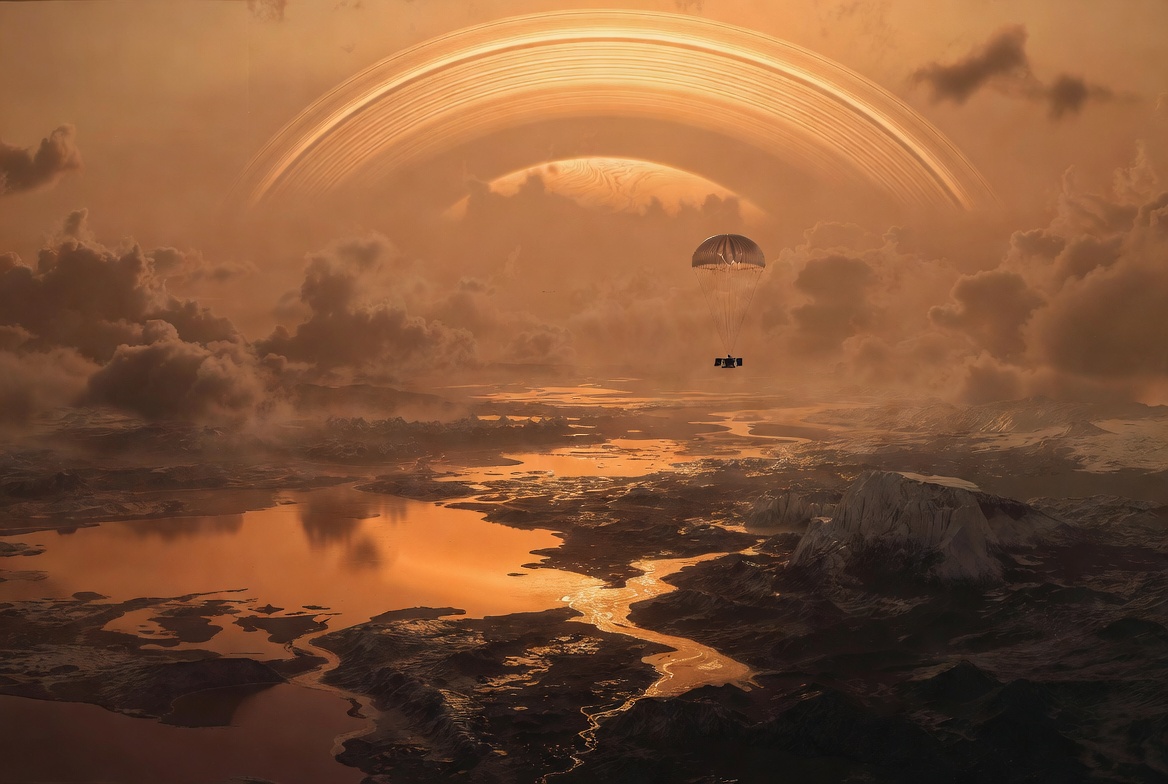
NASA’s color-enhanced images reveal a mysterious orange world wrapped in golden haze, with Saturn’s majestic rings hanging in the sky. It feels like science fiction — but it’s real.
The Great Hope: Three Icy Moons with Hidden Oceans
For years, Titan, Enceladus (also orbiting Saturn), and Europa (orbiting Jupiter) formed the holy trinity of “ocean worlds” in our Solar System. All three show strong evidence of subsurface liquid water oceans — the universal solvent considered essential for life.
Europa: Thin ice crust, possible hydrothermal vents on the seafloor.
Enceladus: Dramatic water plumes shooting from its south pole, rich in organics and energy.
Titan: Thick atmosphere, complex organic chemistry on the surface, and a global subsurface ocean.
Titan stood out because it wasn’t just hiding water — it had a fully active surface environment. Many scientists believed that if life existed anywhere else in the Solar System, Titan was the most likely candidate.
The Bombshell Study: Catherine Neish’s Game-Changing Research
That dream has now been seriously challenged.
In the new Astrobiology paper, Catherine Neish’s team used detailed modeling of impact cratering — the main mechanism that could transport surface organics deep into the subsurface ocean. Their calculations were sobering.
Even with Titan’s incredibly rich organic surface (tholins up to tens of meters thick), the amount of complex organic molecules (such as amino acids like glycine) that could reach the ocean is extremely low — equivalent to roughly one African elephant’s worth of glycine per year delivered into an ocean 12 times larger than Earth’s entire ocean volume.
Neish’s stark conclusion:
“It’s very difficult to get both water and carbon in the same place on Titan. The carbon is stuck on the surface, while the water is locked deep below a thick ice shell.”
This research effectively decouples the two key ingredients for life on Titan: abundant organics on top, liquid water far below, with almost no efficient mixing mechanism.
What This Means for the Search for Life
This is not just another scientific paper — it’s a paradigm shift.
For decades, NASA invested heavily in Titan as a high-priority target. Now, the spotlight is swinging back toward Enceladus and Europa, where water and chemistry are more intimately mixed.
Yet NASA is not abandoning Titan. The upcoming Dragonfly mission, scheduled for launch in 2028 and arrival in 2034, is a revolutionary nuclear-powered drone-rotorcraft that will fly across Titan’s surface, sampling organic-rich dunes and riverbeds directly. Dragonfly may still uncover astonishing prebiotic chemistry — even if it doesn’t find living organisms.
The Philosophical Impact: Are We Alone?
Discoveries like this force us to confront a deeper truth: the universe may be far more hostile to life than we once hoped.
Titan proves that looking “Earth-like” is not enough. You need the right chemistry, the right energy, the right mixing, and the right timing — all in one place. Perhaps life is not a cosmic inevitability, but an incredibly rare and precious accident.
At the same time, Titan remains a treasure trove of organic chemistry. Studying it will teach us how the building blocks of life formed on the early Earth 4 billion years ago.
Final Thoughts
Titan is still one of the most fascinating and beautiful worlds in our Solar System — a golden, hazy mirror of what Earth might have looked like in its youth. But the latest science suggests it is likely a prebiotic world, not a biotic one.
Will Dragonfly prove the models wrong? Could there be exotic methane-based life on the surface that we haven’t even imagined? Or will Titan ultimately teach us humility about how special our own living planet truly is?
The search continues.
What do you think?
Is Titan truly dead, or will future missions still surprise us? Drop your thoughts below and share this article if you’re as fascinated (and slightly heartbroken) as we are.