
Why Is the Ocean Salty?
Why Is the Ocean Salty?
All water on Earth — even rainwater — contains small amounts of dissolved minerals and chemical compounds that scientists often refer to as salts. However, not all water tastes salty. We all know seawater is salty, while rainwater, rivers, lakes, and streams are generally fresh. So why does this difference exist?
How Salty Is Ocean Water?
To understand just how salty the ocean is, imagine a simple experiment. Take a glass of fresh drinking water. You can drink it easily. Add a pinch of salt, and you’ll notice the salty taste, though it may still be tolerable. Keep adding more salt, and eventually the water becomes undrinkable.
This is similar to seawater. Ocean water contains such a high concentration of dissolved salts and minerals that humans cannot safely drink it. Unlike the purified water we rely on daily, seawater is chemically complex and overloaded with substances our bodies cannot process in large quantities.
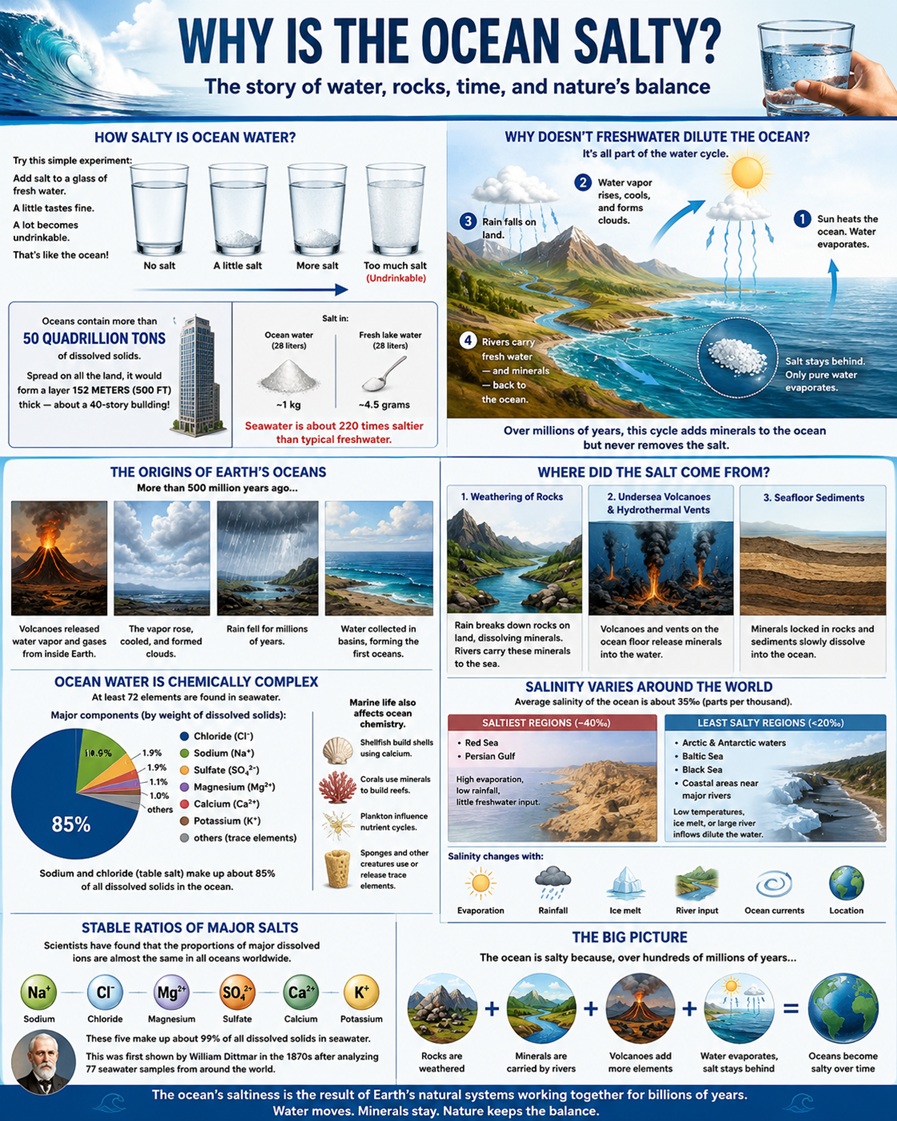
Scientists estimate that Earth’s oceans contain more than 50 quadrillion tons of dissolved solids. If all that salt were removed and spread evenly across Earth’s land surfaces, it would form a layer about 500 feet (152 meters) thick — roughly the height of a 40-story building.
For comparison:
About 1 kilogram (2.2 pounds) of salt is found in every 28 liters (7.4 gallons) of seawater.
Freshwater lakes contain only about 4.5 grams of dissolved salts per 28 liters.
This means seawater is approximately 220 times saltier than typical freshwater.
The Origins of Earth’s Oceans
Earth’s oceans are ancient, estimated to be more than 500 million years old based on fossil records and geological studies.
Many scientists believe both the atmosphere and oceans gradually formed during Earth’s early geological development through a process called outgassing. During this period:
Molten rock inside Earth released water vapor and gases
These gases rose into the atmosphere
As Earth cooled, water vapor condensed into clouds
Rain fell continuously for millions of years
Water collected in basins, forming the first primitive oceans
Gravity kept this water bound to Earth, allowing oceans to persist.
Where Did the Salt Come From?
Ocean salt primarily comes from two major sources:
1. Weathering of Rocks on Land
Rainwater is naturally slightly acidic due to dissolved carbon dioxide. Over millions of years, rain eroded rocks and carried dissolved minerals — including sodium, calcium, chloride, and magnesium — into rivers and streams.
These rivers eventually emptied into the oceans, continuously delivering dissolved minerals.
2. Hydrothermal Vents and Underwater Volcanic Activity
Deep-sea hydrothermal vents and volcanic eruptions also release minerals directly into seawater from Earth’s crust.
Together, these processes gradually increased ocean salinity over vast timescales.
Why Doesn’t Freshwater Dilute the Ocean?
Rivers constantly pour freshwater into the oceans, so why doesn’t seawater become less salty?
The answer lies in the water cycle:
Sunlight causes ocean water to evaporate
Salt is left behind because it does not evaporate
Water vapor forms clouds
Rain falls over land
Rivers return water to the sea, carrying new minerals
This cycle repeats endlessly.
Because evaporation removes pure water while leaving salts behind, the ocean gradually accumulates salts over time.
Ocean Water Is Chemically Complex
Ocean water is far more than just saltwater. Scientists have identified at least 72 naturally occurring elements dissolved in seawater, though many believe nearly all naturally occurring elements on Earth may be present in trace amounts.
The major dissolved substances include:
Sodium (Na)
Chloride (Cl)
Magnesium
Sulfate
Calcium
Potassium
Sodium and chloride — the components of table salt (NaCl) — account for about 85% of all dissolved solids in seawater.
Salinity Varies Around the World
Average ocean salinity is about 35 parts per thousand (35‰), but this varies depending on:
Evaporation rates
Rainfall
Ice melt
River input
Geographic location
Ocean currents
Saltiest Regions:
Red Sea
Persian Gulf
These areas experience intense evaporation and limited freshwater input, reaching salinity levels around 40‰.
Least Salty Regions:
Arctic waters
Antarctic waters
Coastal areas near major rivers
Baltic Sea
Black Sea
These regions are diluted by melting ice or large freshwater inflows.
Marine Life Also Influences Ocean Chemistry
Marine organisms actively alter seawater composition.
Examples include:
Shellfish extract calcium to build shells
Coral uses minerals for reef construction
Plankton influences carbon and nutrient cycles
Sponges and certain species can absorb trace elements like iodine or vanadium
These biological processes help regulate some ocean chemistry, though sodium remains largely unaffected.
Stable Ratios of Major Salts
While salinity levels differ by location, the proportions of major dissolved ions remain remarkably consistent worldwide.
This principle, first systematically studied by chemist William Dittmar in the 19th century, showed that:
Sodium chloride
Magnesium compounds
Sulfates
Calcium
Potassium
make up roughly 99% of dissolved ocean solids almost everywhere.
Conclusion
The ocean is salty because, for hundreds of millions of years:
Rain eroded rocks
Rivers transported dissolved minerals
Volcanoes and hydrothermal vents added more elements
Water evaporated, leaving salts behind
Over time, these processes transformed Earth’s oceans into the salty bodies of water we know today.
In short:
The sea is salty because Earth’s natural geological and hydrological systems have been slowly collecting and concentrating dissolved minerals for billions of years.
This ongoing balance between water movement, mineral input, and evaporation explains why oceans remain salty while rivers and lakes generally stay fresh.