Cosmic Dawn: How the First Galaxies Lit Up the Universe
Cosmic Dawn: How the First Galaxies Lit Up the Universe
The Big Questions About the Early Universe After the Big Bang
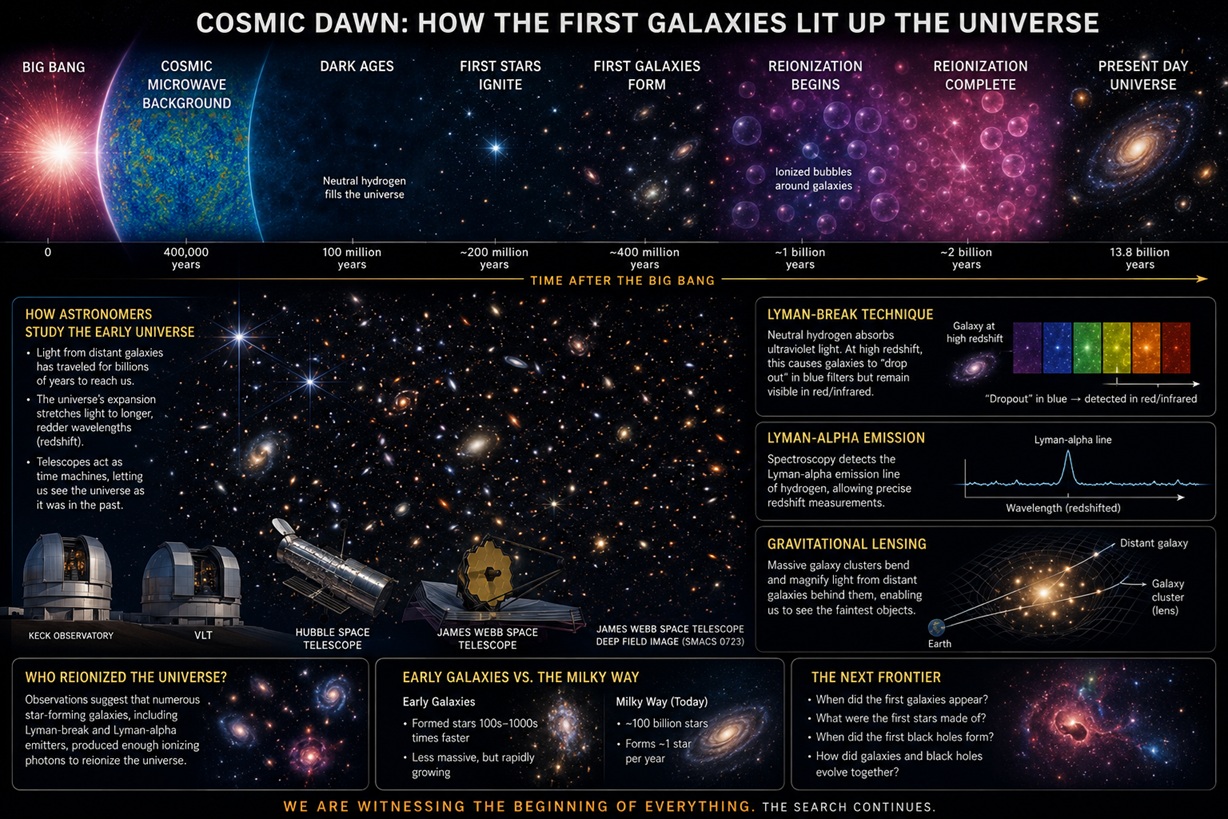
Roughly 14 billion years ago, our universe was born in the Big Bang. In its earliest moments, it was unimaginably hot and dense, filled only with fundamental particles. As the universe expanded rapidly, it cooled over time. About 400,000 years later, temperatures dropped enough for protons and electrons to combine, forming neutral hydrogen atoms.
This marked a critical turning point: the universe became transparent. Radiation from the Big Bang could finally travel freely, creating what we now observe as the cosmic microwave background. Yet after this moment, the cosmos entered a long “dark age.” There were no stars, no galaxies, and no visible sources of light—only vast clouds of neutral hydrogen drifting through space.
Over hundreds of millions of years, gravity slowly pulled these hydrogen clouds together. As they collapsed, their cores heated up until nuclear fusion ignited, producing the first stars. These stars became the seeds of the first galaxies.
For the first time, light returned to the universe.
This period, often called the “Cosmic Dawn,” transformed everything. Radiation from these early stars began ionizing the surrounding neutral hydrogen, carving out enormous bubbles of ionized gas. As more stars and galaxies formed, these bubbles expanded and merged, gradually reionizing the entire universe into the state we observe today.
While this broad picture is widely accepted, many of its details remain uncertain. Key unanswered questions include:
When exactly did the first stars and galaxies form?
What types of galaxies were most responsible for cosmic reionization?
Did quasars or star-forming galaxies dominate this process?
Were there enough early galaxies to fully reionize the universe?
Modern astronomy seeks to answer these questions through direct observation rather than theory alone.
Looking Back in Time: How Astronomers Study the Ancient Universe
Because the universe is expanding, distant galaxies are moving away from us. The farther away a galaxy is, the faster it recedes, stretching its light into longer, redder wavelengths—a phenomenon known as redshift.
This means telescopes act as time machines.
When astronomers observe galaxies billions of light-years away, they are seeing them as they existed billions of years in the past. By measuring redshift, scientists can determine both distance and cosmic age.
Today, astronomers have identified galaxies that existed only a few hundred million years after the Big Bang, when the universe was less than 5% of its current age.
However, these ancient galaxies are incredibly faint, making them extraordinarily difficult to detect.
To piece together galactic evolution, scientists study thousands of galaxies at different stages of development, constructing a larger evolutionary timeline rather than tracking any single galaxy.
Advances in telescope technology—from ground-based observatories like Keck Observatory and Very Large Telescope to space telescopes like Hubble Space Telescope and James Webb Space Telescope—have dramatically expanded humanity’s reach into the distant cosmos.
The Lyman-Break Technique: Finding Ancient Galaxies
One of the most effective methods for detecting distant galaxies relies on the behavior of hydrogen.
Neutral hydrogen strongly absorbs ultraviolet (UV) light. For very distant galaxies, this absorption signature becomes shifted into visible or infrared wavelengths due to cosmic redshift.
Astronomers use multiple color filters to observe galaxies. If an object suddenly “disappears” in shorter wavelengths but remains visible in longer wavelengths, it becomes a strong candidate for being a very distant galaxy.
This method is known as the Lyman-break technique, and galaxies discovered this way are called Lyman-break galaxies.
This approach revolutionized deep-sky surveys, including the famous Hubble Ultra Deep Field project, which revealed thousands of galaxies in what previously appeared to be an empty patch of sky.
Lyman-Alpha Emission: Measuring Cosmic Distances More Precisely
While the Lyman-break method is powerful, it does not provide highly precise redshift measurements.
For greater accuracy, astronomers use spectroscopy to detect specific emission lines, especially the Lyman-alpha line of hydrogen.
This line is one of the brightest features in star-forming galaxies, allowing researchers to determine redshifts with much greater confidence.
Instruments such as the MUSE spectrograph on the VLT have made this possible.
A major surprise came when the James Webb Space Telescope detected Lyman-alpha emission from galaxies at redshift z = 10.6—just over 400 million years after the Big Bang. This was unexpected because the early universe was thought to be filled mostly with neutral hydrogen, which should strongly absorb Lyman-alpha photons.
Such discoveries suggest that galaxy formation and cosmic reionization may have progressed faster than previously believed.
Gravitational Lensing: Nature’s Own Telescope
Another breakthrough method for studying the early universe uses Einstein’s theory of general relativity.
Massive galaxy clusters can bend and magnify light from galaxies behind them, creating a phenomenon known as strong gravitational lensing.
This natural magnification allows astronomers to detect galaxies that would otherwise be too faint to observe.
The James Webb Space Telescope’s first deep field image of galaxy cluster SMACS 0723 beautifully demonstrated this effect, revealing numerous distant galaxies whose light had been warped and amplified by gravitational lensing.
This technique has become one of the most powerful tools for probing the earliest stages of galaxy formation.
Who Reionized the Universe?
Recent observations increasingly suggest that star-forming galaxies—particularly Lyman-break and Lyman-alpha emitters—were the primary drivers of cosmic reionization.
Large observational studies indicate:
Fainter galaxies were far more numerous than brighter ones
The total population of these galaxies likely produced enough ionizing photons
Lyman-alpha emitting galaxies played a major role in completing reionization around one billion years after the Big Bang
These findings are helping resolve one of cosmology’s biggest mysteries.
Early Galaxies vs. the Milky Way
Ancient galaxies were dramatically different from mature galaxies like our own Milky Way.
The Milky Way contains roughly 100 billion stars and forms about one new star per year.
By contrast, many early galaxies formed stars hundreds or even thousands of times faster.
This intense star formation suggests that galaxies in the early universe grew rapidly, evolving far more quickly than once assumed.
Recent studies also show that relationships between stellar mass and star formation rate—key indicators of galaxy evolution—extend even to much smaller galaxies than previously measured.
The Next Frontier
Despite enormous progress, many profound questions remain:
When did the very first galaxies appear?
What were the first stars made of?
Can we detect pristine galaxies composed only of hydrogen and helium?
When did the first black holes emerge?
How did galaxies and supermassive black holes evolve together?
The James Webb Space Telescope has already shattered previous observational records, continuously pushing deeper into cosmic history.
Each new discovery not only answers old questions—it raises new ones.
There are growing hints that galaxies may have formed faster, matured earlier, and become more complex sooner than existing theories predicted.
A New Era of Cosmic Exploration
We are living through one of the most exciting periods in the history of astronomy.
For the first time, humanity possesses the tools to directly study the universe’s earliest structures. Telescopes like James Webb Space Telescope are not merely extending our cosmic horizon—they are rewriting our understanding of how everything began.
The search for cosmic dawn is far from over.
And history suggests that our greatest discoveries may still lie ahead.