If you’re fascinated by ancient history and the mysteries of early civilizations, few places capture the imagination quite like Abu Simbel — a breathtaking temple complex carved into solid rock over 3,000 years ago in southern Egypt, along the banks of the Nile River.
If you’re fascinated by ancient history and the grandeur of early civilizations, few places are as awe-inspiring as Abu Simbel—a monumental temple complex carved into rock over 3,000 years ago. Located in southern Egypt along the banks of the Nile River, Abu Simbel dates back to the 13th century BCE, when Egypt was at the height of its power during the New Kingdom.
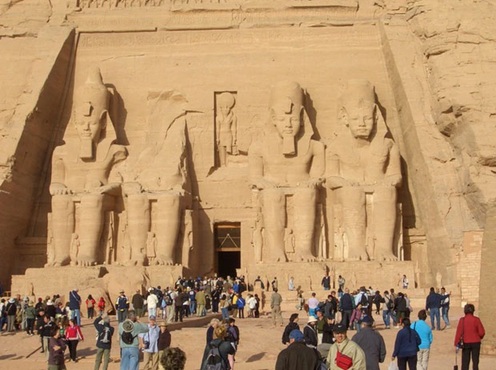
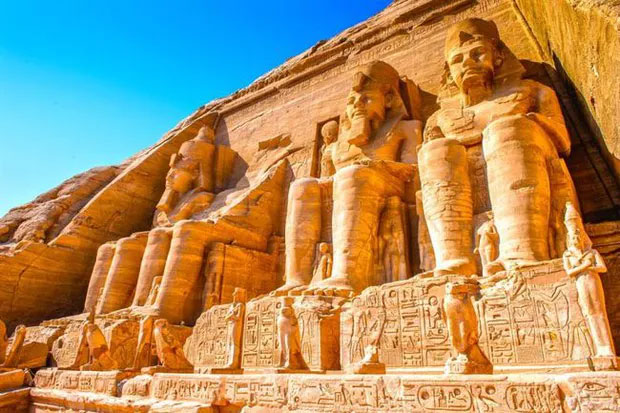
Commissioned by the legendary pharaoh Ramesses II, the temples were built not just as places of worship, but as bold statements of authority. Positioned near the southern frontier of Egypt’s empire, they were meant to impress—and intimidate—anyone approaching from Nubia. The site features colossal rock-cut structures, including four massive seated statues of Ramesses II guarding the entrance—among the largest surviving sculptures from ancient Egypt.
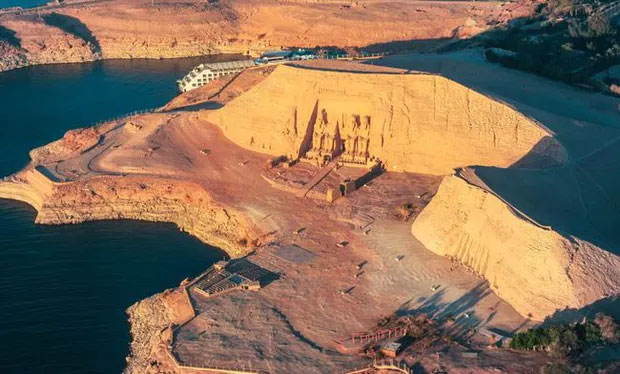
Abu Simbel is located in Abu Simbel – a small village of Aswan in Upper Egypt near the border with Sudan, on the western shore of Lake Nasser.
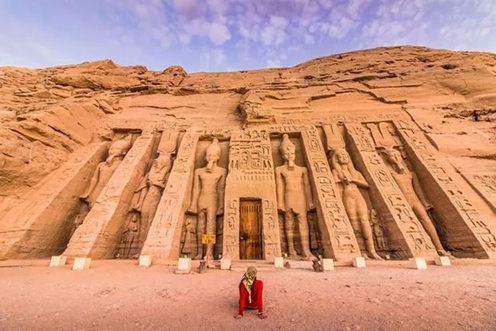
The complex consists of two main temples: the Great Temple, dedicated to Ramesses II and several major deities, and the Small Temple, built in honor of his queen, Nefertari. Together, they stand as a tribute to royal power, divine connection, and architectural brilliance.
For centuries, Abu Simbel was lost to time. Shifting desert sands buried nearly the entire site, leaving only the tops of the statues visible. It wasn’t until 1813 that Swiss explorer John Lewis Burckhardt rediscovered the temples. Even then, it took decades of excavation before the complex was fully revealed, with the final layers of sand cleared in the early 20th century.
Today, Abu Simbel is one of the most iconic archaeological sites in Egypt—but its true brilliance lies beyond its sheer size.
The Great Temple, which took about 20 years to complete, is dedicated to gods such as Ptah, Amun-Re, and Re-Harakti, as well as Ramesses II himself. It is widely considered one of the finest temples ever built during his reign.
The Small Temple, meanwhile, honors both the goddess Hathor and Queen Nefertari. Its façade is adorned with towering statues of the queen and the king—remarkably, Nefertari is depicted at the same scale as Ramesses II, a rare and powerful symbol of her importance.
But perhaps the most astonishing feature of Abu Simbel is its solar alignment—a feat of engineering that still amazes scientists and historians today.
Twice a year, around February 21 and October 21, sunlight penetrates deep into the inner sanctuary of the Great Temple, illuminating statues of Ramesses II and the gods seated beside him. The light first touches Amun-Re, then gradually reaches the other figures—except for Ptah, the god associated with darkness, who remains in shadow.
This precise alignment has remained accurate for over three millennia.
It’s hard to overstate what this represents. Without modern instruments, ancient Egyptian architects were able to calculate solar movement with extraordinary precision—embedding cosmic symbolism directly into stone.
Abu Simbel isn’t just a temple. It’s a statement: of power, of belief, and of a civilization whose understanding of the world was far more advanced than many realize.