Orchid Mantis: A Beautiful Flower-Like Predator with Ruthless Hunting Skills
Orchid Mantis: A Beautiful Flower-Like Predator with Ruthless Hunting Skills
Looking almost exactly like a delicate orchid blossom—complete with gentle swaying motions that mimic petals moving in the breeze—the orchid mantis is actually one of nature’s most deceptive and deadly predators.
With its stunning flower-like appearance, the orchid mantis (scientific name: Hymenopus coronatus) is widely regarded as one of the greatest masters of camouflage in the insect world, captivating scientists and insect enthusiasts alike.
Native primarily to tropical rainforests across Thailand, Malaysia, Indonesia, India, Singapore, and Vietnam, this extraordinary insect is nearly invisible among flowering plants.
Nature’s Perfect Floral Illusion
Despite its name, the orchid mantis does not actually live on orchids. Instead, it has evolved to resemble an orchid flower with astonishing precision.
Its body features soft white and pink coloring, broad abdominal structures, and petal-shaped lobes on its legs, all of which create the illusion of flower petals. Only its spiked front legs reveal its true identity as a mantis—specialized tools designed to seize prey with lightning-fast precision.
Adult females typically grow to about 2.5 to 3 inches long (6–7 cm), while males are much smaller, averaging only about 1 inch (2.5 cm).
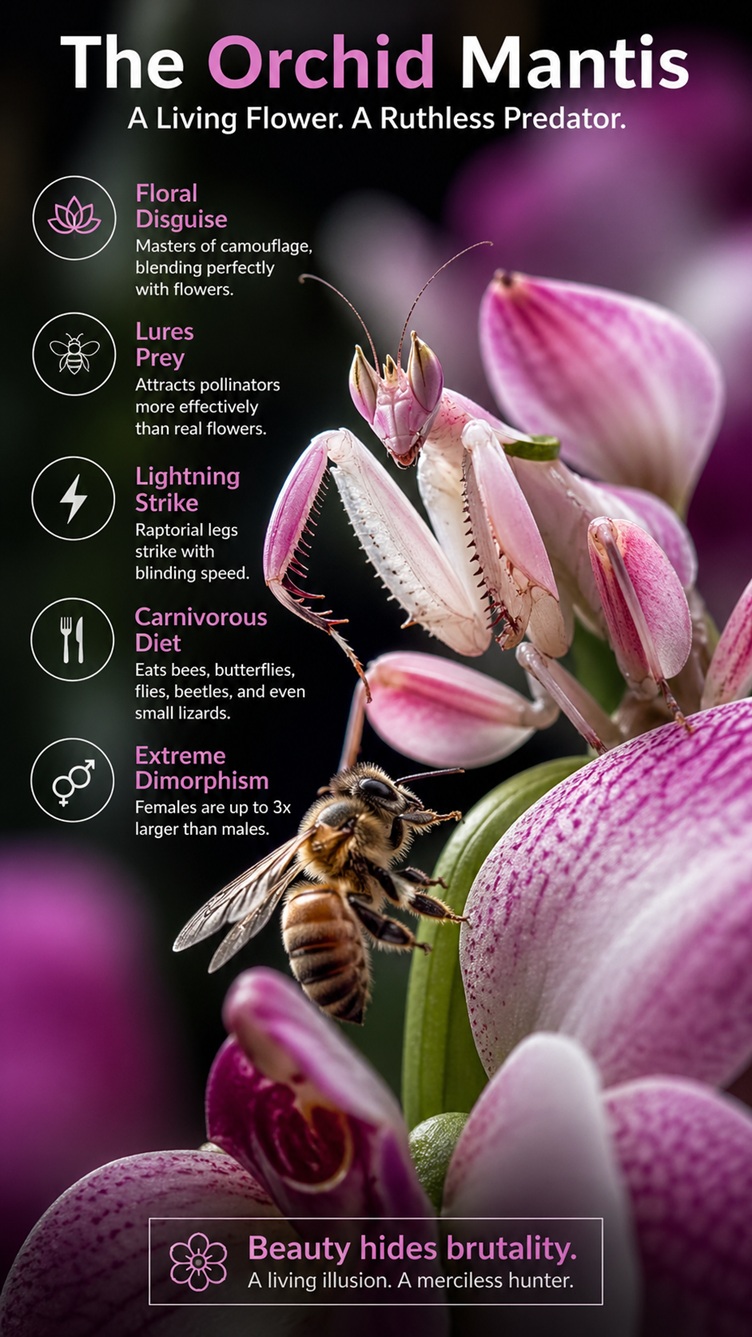
Even more impressively, orchid mantises can subtly alter their coloration based on environmental conditions such as temperature and light, allowing them to blend seamlessly with nearby flowers. Scientists have documented over 90 different color variations depending on their habitat.
To enhance the illusion, they also sway gently like petals in the wind, making them even more convincing to both predators and unsuspecting prey.
More Attractive Than Real Flowers
One of the most remarkable discoveries about orchid mantises is that they often attract pollinating insects more effectively than actual flowers.
Rather than simply hiding, they actively exploit the visual instincts of bees, butterflies, and other nectar-seeking insects. Their appearance functions as an irresistible supernormal stimulus—essentially tricking insects into perceiving them as an especially rewarding flower.
Researchers found that pollinators frequently alter their flight paths and head directly toward the mantis, only to be captured in a deadly ambush.
A Patient and Efficient Killer
Unlike active hunters, orchid mantises rely on stillness and deception.
They remain motionless for hours, perched on branches, leaves, or flowers, waiting for prey to approach. Once within reach, they strike with astonishing speed using their raptorial forelegs.
Their diet mainly consists of:
Bees
Butterflies
Flies
Beetles
However, larger individuals have also been known to prey on:
Small frogs
Lizards
Even scorpions
This aggressive predatory behavior makes them highly efficient carnivores despite their delicate appearance.
Scientific Revelations: More Than Camouflage
For over a century, scientists believed orchid mantises evolved their appearance mainly for defensive camouflage.
However, field studies conducted in 2014 revealed a far more sinister truth: their floral disguise is actually a form of aggressive mimicry.
Rather than merely blending in, orchid mantises actively lure prey by exploiting insects’ sensory biases. They do not necessarily imitate one specific flower species but instead capitalize on general pollinator attraction to certain colors and shapes.
This makes them not passive mimics, but active predators using sophisticated evolutionary deception.
Extreme Sexual Dimorphism
Orchid mantises also display one of the most dramatic size differences between sexes in the insect world.
Females are often three times larger than males—a rare evolutionary adaptation believed to improve female hunting success rather than reproduction alone.
According to research led by Gavin Svenson at the Cleveland Museum of Natural History, females evolved larger size and floral mimicry primarily to become superior predators.
Meanwhile, males remain small and mobile, increasing their chances of:
Avoiding predators
Escaping cannibalism by females
Successfully locating mates
Beauty Hiding Brutality
The orchid mantis is a stunning example of how beauty in nature can conceal extraordinary lethality.
Beneath its elegant, flower-like exterior lies a highly specialized ambush predator—one that manipulates perception, exploits instinct, and kills with ruthless efficiency.
In the natural world, few creatures embody deception more perfectly than the orchid mantis: a living flower that is, in reality, a merciless hunter.