Paper: Its Origins and Evolution
Paper: Its Origins and Evolution
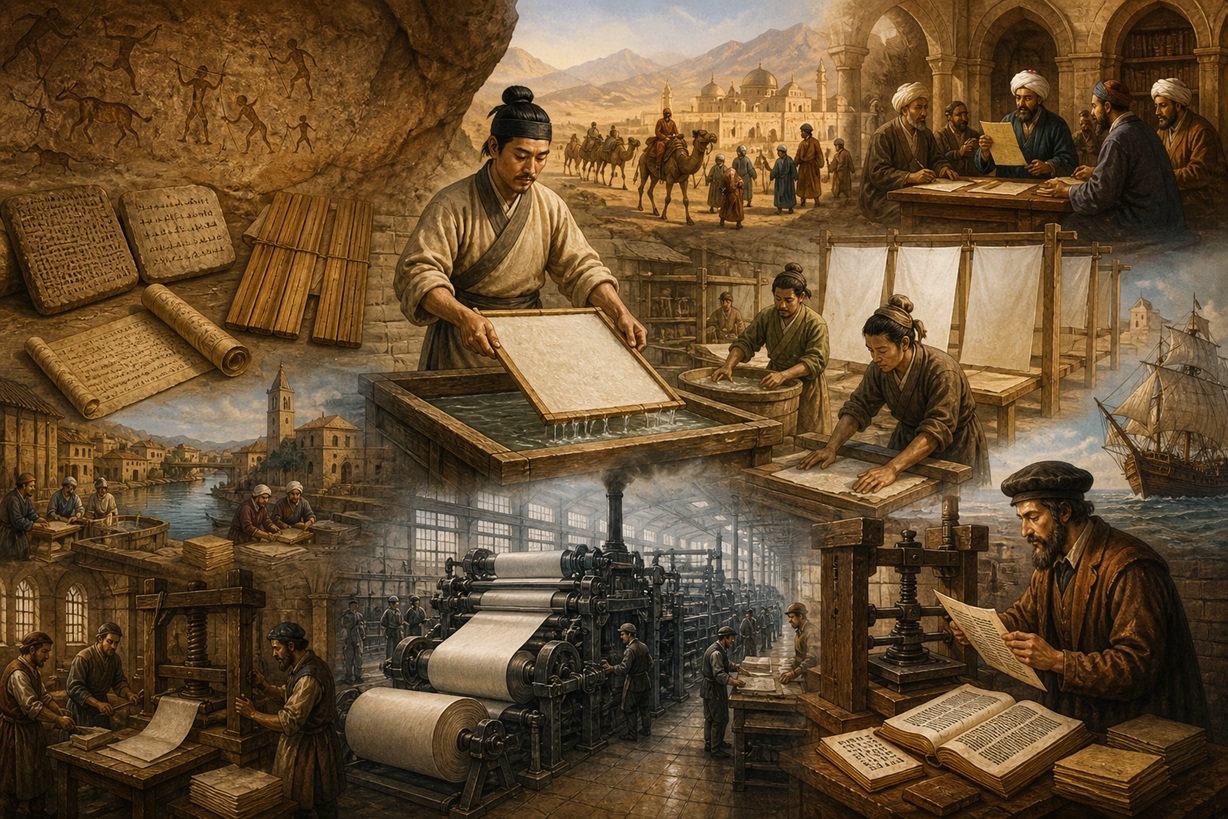
Today, paper feels so ordinary that we crumple it up and throw it away without a second thought. Yet behind this everyday material lies a remarkable journey spanning thousands of years. From the earliest carvings on cave walls and clay tablets over 3,000 years ago to the invention of primitive paper about 2,000 years ago, paper has undergone an extraordinary transformation before becoming the essential resource we rely on today.
Archaeological discoveries in China, supported by radiocarbon dating, suggest that paper existed at least two centuries before Ts’ai Lun. However, Ts’ai Lun is still widely credited as the true inventor of practical papermaking as we know it.
Ts’ai Lun: The Father of Modern Paper
In 105 CE, during the Han Dynasty under Emperor Ho Ti of China, Ts’ai Lun presented samples of his newly developed paper to the imperial court. The emperor was highly impressed, rewarding him with noble status and an influential government position.
Ts’ai Lun, a court eunuch responsible for managing imperial wealth, used materials such as mulberry bark, bamboo fibers, old rags, and fishing nets. He soaked these materials in water, mashed them into pulp using wooden tools, spread the mixture thinly over stretched cloth screens, and allowed it to dry. The result was a lightweight, inexpensive writing surface that was far more practical than bamboo strips or silk.
This innovation revolutionized communication and recordkeeping in China. From there, papermaking gradually spread to Korea, Central Asia, Baghdad, and Damascus.
Although Ts’ai Lun’s invention emerged early, it took many centuries before paper production expanded throughout Eurasia.
The Spread of Papermaking Across the World
By around 400 CE, papermaking had reached India.
Several centuries later, the Abbasid Caliphate adopted paper, and Islamic societies quickly embraced it. From India to Spain, the Islamic world used paper extensively, while much of Christian Europe still relied on parchment made from animal skins.
A key turning point occurred in 751 CE at the Battle of Talas near Samarkand. Arab forces captured Chinese prisoners skilled in papermaking, who shared their knowledge in exchange for freedom. This event allowed papermaking techniques to spread rapidly throughout the Islamic world.
By the 10th century, Arab manufacturers improved paper quality by using cotton fibers, producing thinner and finer sheets.
As Islamic influence expanded across North Africa, Sicily, Spain, and parts of Europe, papermaking technology followed. Even after Christian kingdoms regained these territories, the paper industry remained.
Around 1100: Italy and Spain continued paper production
1250: Italian papermakers began supplying paper across Europe
1338: France started domestic paper manufacturing
1411: Germany began producing paper
The invention of Johannes Gutenberg’s printing press around 1450 dramatically accelerated demand for paper. Affordable, uniform, and mass-producible, paper replaced vellum and parchment as the dominant writing medium.
Ts’ai Lun vs. Gutenberg: Which Invention Was More Transformative?
Before paper:
In China, books were written on heavy bamboo strips or expensive silk
In the West, parchment and papyrus were costly and limited
Ts’ai Lun’s invention made writing materials cheaper and more accessible. Gutenberg’s printing press later amplified this impact by enabling mass production of books.
While Gutenberg transformed information distribution, Ts’ai Lun arguably laid the essential foundation. Without affordable paper, large-scale printing would have been far less practical.
Paper also extended beyond books, becoming vital for administration, education, packaging, art, and countless other uses.
Paper’s Role in the Rise of Civilizations
Papermaking significantly boosted Chinese civilization. Once China adopted paper, government administration, scholarship, and literature flourished rapidly, allowing Chinese culture to surpass much of medieval Europe for centuries.
Marco Polo himself noted China’s remarkable prosperity in the 13th century.
However, by the 15th century, Europe gained a major advantage through Gutenberg’s movable-type printing press. While China continued using block printing, Europe’s more efficient printing technologies accelerated literacy, scientific exchange, and cultural development.
The Industrial Revolution and Modern Papermaking
Until the 1800s, paper was still handmade from hemp, linen, cotton, and other fibers.
In the late 18th century, French inventor Louis-Nicolas Robert developed one of the first machines capable of producing continuous rolls of paper. This mechanization dramatically lowered costs and increased production speed.
By the mid-19th century:
Wood pulp became the primary raw material
Large-scale paper mills expanded globally
Printing, publishing, newspapers, and education industries exploded
The industrialization of papermaking transformed paper from a luxury item into an affordable necessity, fueling modern communication and mass literacy.
Conclusion
The history of paper is a story of innovation, cultural exchange, and technological progress. From Ts’ai Lun’s early experiments in ancient China to industrial paper mills in modern Europe and America, paper has shaped education, governance, religion, science, and global civilization.
Though often overlooked today, paper remains one of humanity’s most influential inventions—an enduring symbol of knowledge, communication, and progress.