Scientists Develop Revolutionary Powder That Captures CO₂ More Efficiently Than Trees
Scientists Develop Revolutionary Powder That Captures CO₂ More Efficiently Than Trees
According to a groundbreaking study published in Nature on October 23, scientists have created a new powder capable of removing carbon dioxide (CO₂) from the atmosphere far more efficiently than traditional tree planting.
While an average tree absorbs about 40 kilograms of CO₂ each year, researchers at the University of California, Berkeley say just 200 grams of their fine yellow powder can achieve a similar result.
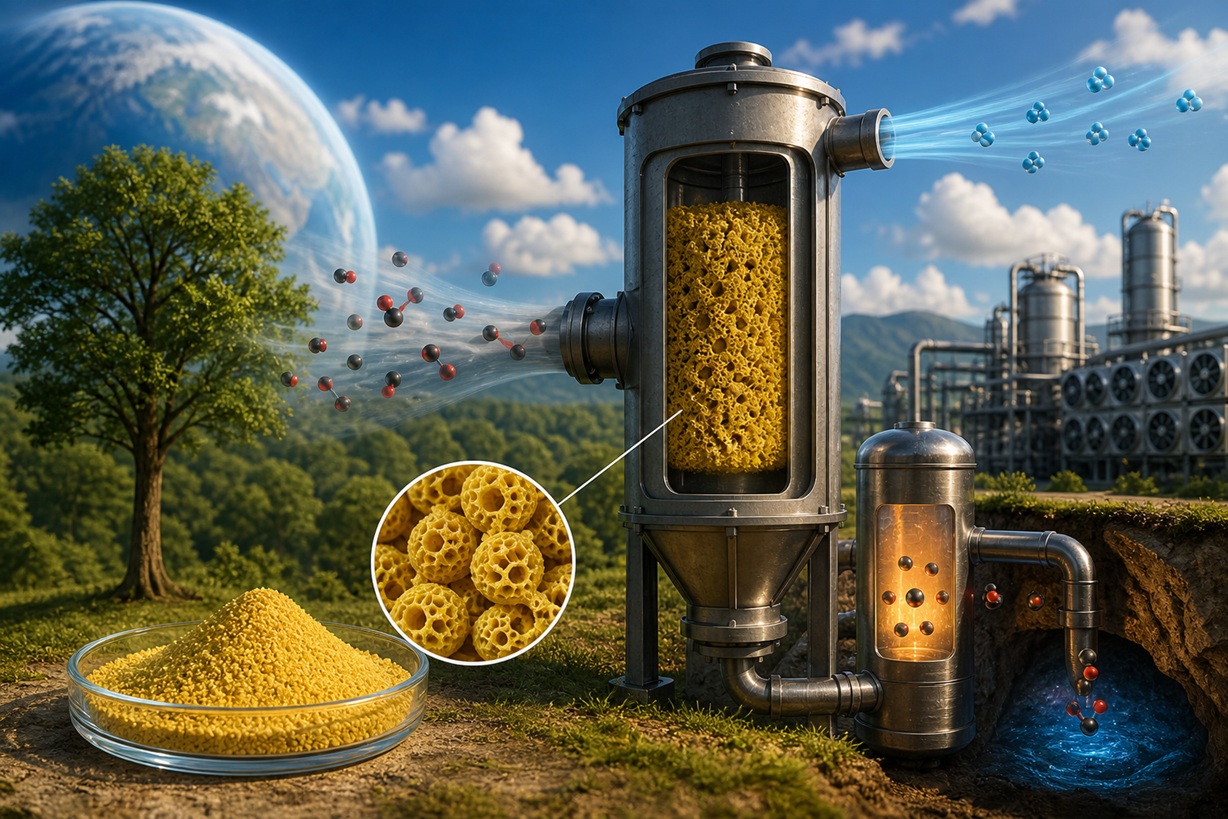
This innovative material, called COF-999, consists of microscopic porous particles filled with billions of tiny holes that trap greenhouse gases. Once captured, the CO₂ can be extracted from the powder using low heat and then permanently stored underground, preventing it from contributing to global warming.
In laboratory tests, COF-999 maintained excellent performance even after 100 capture-and-release cycles, with researchers believing it could potentially function for thousands of cycles.
Lead researcher Omar Yaghi, a chemist at UC Berkeley, explained:
“Based on the material’s current stability and activity, we believe it could remain effective for thousands of cycles.”
How COF-999 Works
Under an electron microscope, the powder resembles tiny basketball-like structures full of microscopic pores. These frameworks are held together by some of nature’s strongest chemical bonds, including carbon-carbon bonds similar to those found in diamonds.
Special compounds called amines are integrated into the structure. As air passes through, most gases flow freely, but the amines selectively attract and bind acidic CO₂ molecules.
Once saturated, the powder is heated to approximately 60°C (140°F), releasing the captured CO₂ for collection and storage. This lower temperature requirement is a major advantage over existing carbon capture materials, many of which require heating to around 120°C (248°F)—making them significantly more energy-intensive.
Major Advantages Over Existing Carbon Capture Technology
Researchers say COF-999 offers several key benefits:
10 times faster CO₂ capture than many current direct air capture materials
Lower energy consumption due to reduced heating requirements
Exceptional durability, with newer versions surviving over 300 cycles
Scalability, using relatively inexpensive and widely available materials
In real-world outdoor testing, Berkeley scientists packed the powder into a stainless-steel tube and exposed it to ambient air for 20 consecutive days. Incoming air contained CO₂ levels between 410 and 517 parts per million (ppm), yet no detectable CO₂ was found in the air exiting the system.
Why This Matters
Scientists warn that atmospheric CO₂ concentrations must remain below approximately 450 ppm to limit global warming to 2°C above pre-industrial levels. Current measurements from Hawaii’s Mauna Loa Observatory place atmospheric CO₂ at roughly 423 ppm, meaning rapid intervention is increasingly urgent.
Yaghi emphasized:
“We have to remove CO₂ directly from the air. Even if emissions stopped tomorrow, we would still need to pull existing carbon dioxide out of the atmosphere.”
Challenges Ahead
Despite its promise, experts caution that large-scale deployment still faces major hurdles:
Industrial-scale production costs
Energy demands for carbon storage underground
Infrastructure development
Reducing total direct air capture costs by at least tenfold
Klaus Lackner, director of Arizona State University’s Center for Negative Carbon Emissions, called the research highly promising:
“This opens the door to an entirely new range of approaches.”
Looking Forward
Yaghi’s startup, Atoco, is already working to commercialize COF-999, with hopes of deploying it in large-scale carbon capture plants within the next two years.
If successful, this technology could become one of the most powerful tools yet developed to combat climate change—potentially transforming the way humanity removes excess carbon from the atmosphere.