Vincent van Gogh (1853–1890) is widely recognized today as one of history’s greatest artists, though true recognition came only after his death. During his short and troubled life, the Dutch painter struggled with poverty, emotional turmoil, and severe mental health challenges that deeply influenced his work.
Vincent van Gogh (1853–1890) is widely recognized today as one of history’s greatest artists, though true recognition came only after his death. During his short and troubled life, the Dutch painter struggled with poverty, emotional turmoil, and severe mental health challenges that deeply influenced his work.
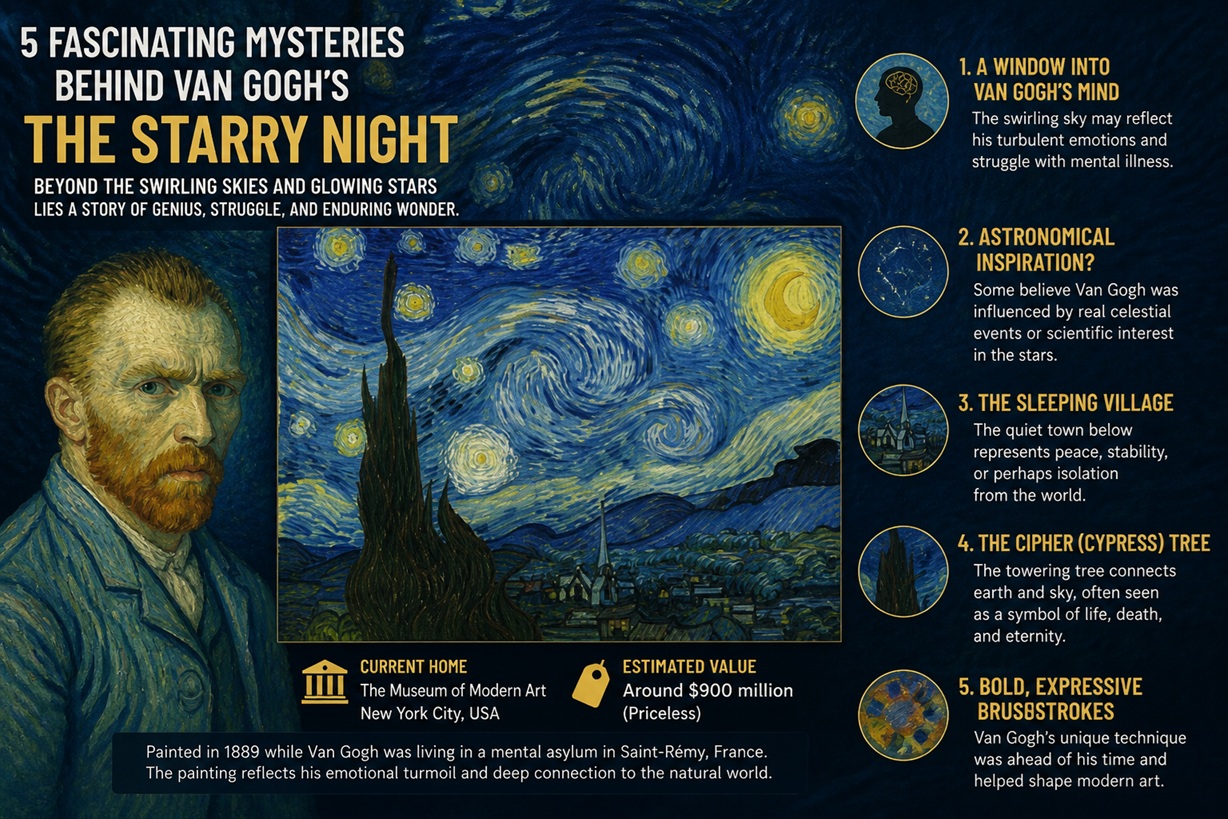
Among his most iconic masterpieces is The Starry Night (1889), a breathtaking oil painting that has become one of the most celebrated works in Western art. With its swirling skies, glowing stars, and dreamlike village, the painting captures far more than a nighttime landscape—it offers a glimpse into Van Gogh’s inner world during one of the darkest periods of his life.
Currently housed at the Museum of Modern Art (MoMA) in New York City, The Starry Night is considered priceless, with estimates placing its value near $900 million.
But beyond its dazzling celestial beauty lies a deeper story. Behind the luminous stars and hypnotic spirals are fascinating mysteries, hidden meanings, and emotional truths that continue to captivate art lovers around the world. From Van Gogh’s mental state to possible astronomical symbolism, The Starry Night remains a powerful blend of genius, pain, and enduring wonder.
1. Van Gogh Painted The Starry Night While in a Mental Institution
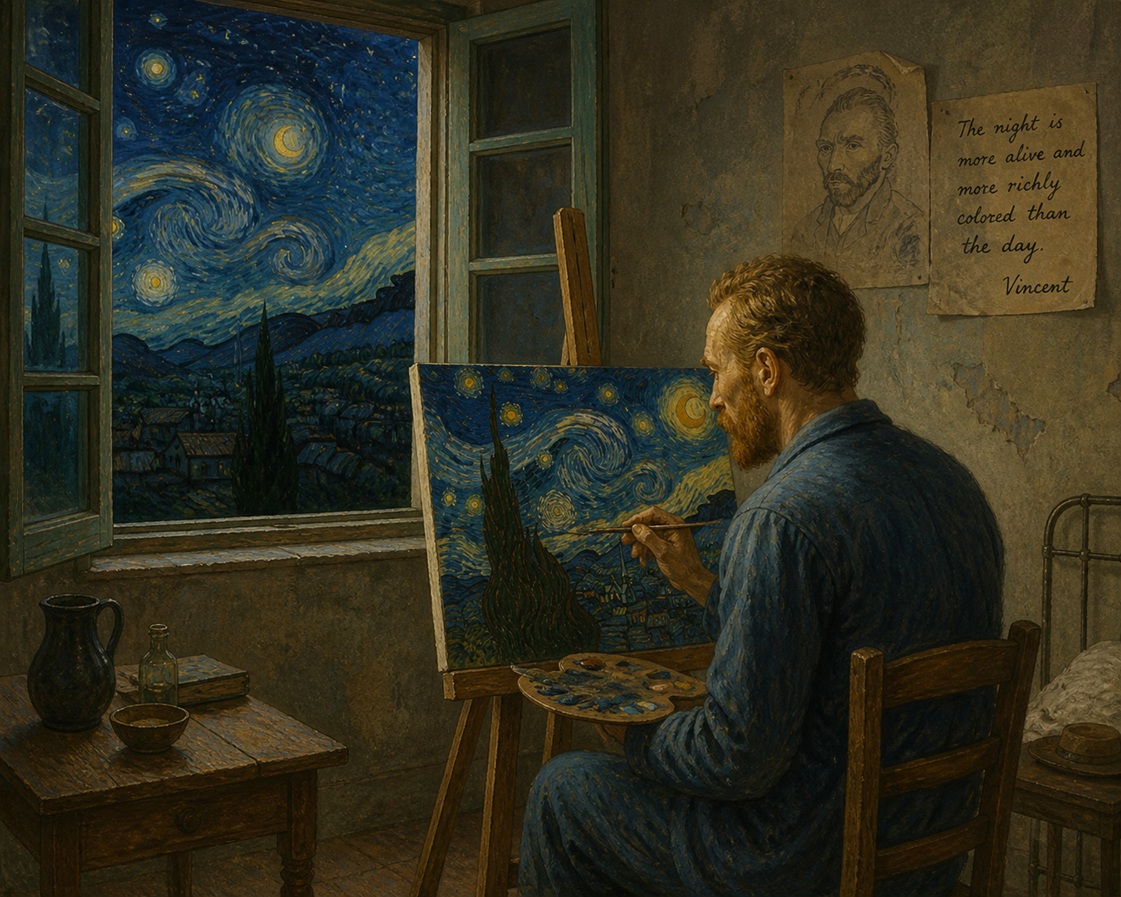
In June 1889, just one year before his death, Vincent van Gogh voluntarily admitted himself to the asylum at Saint-Rémy-de-Provence after suffering severe mental health struggles.
From his east-facing room window, he observed the pre-dawn sky and later recreated it largely from memory during the daytime. Rather than painting exactly what he saw, Van Gogh removed the iron bars from his view and transformed the landscape into an expansive, dreamlike cosmic vision.
This wasn’t simply a landscape—it was an emotional escape.
2. The Painting Reflects Van Gogh’s Fascination with Death
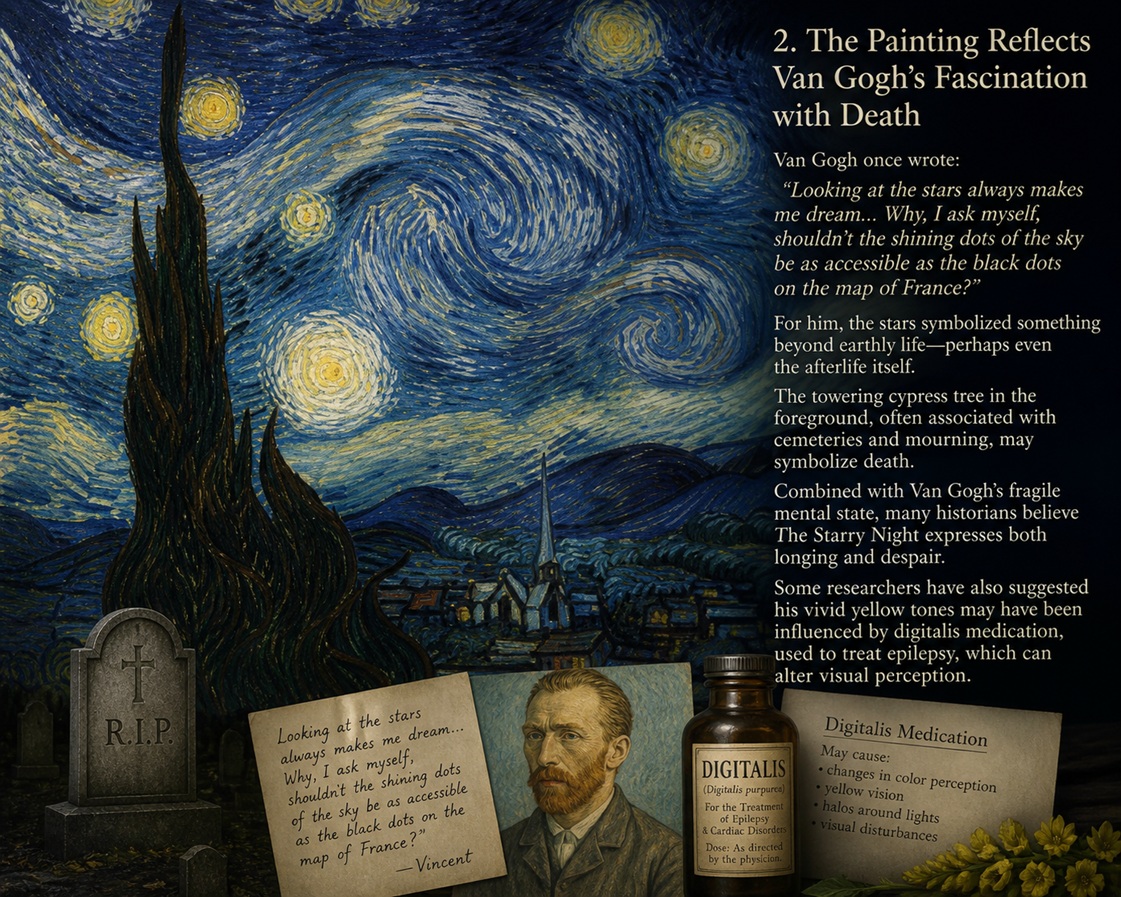
Van Gogh once wrote:
“Looking at the stars always makes me dream... Why, I ask myself, shouldn’t the shining dots of the sky be as accessible as the black dots on the map of France?”
For him, the stars symbolized something beyond earthly life—perhaps even the afterlife itself.
The towering cypress tree in the foreground, often associated with cemeteries and mourning, may symbolize death. Combined with Van Gogh’s fragile mental state, many historians believe The Starry Night expresses both longing and despair.
Some researchers have also suggested his vivid yellow tones may have been influenced by digitalis medication, used to treat epilepsy, which can alter visual perception.
3. There Are Actually Two “Starry Nights”
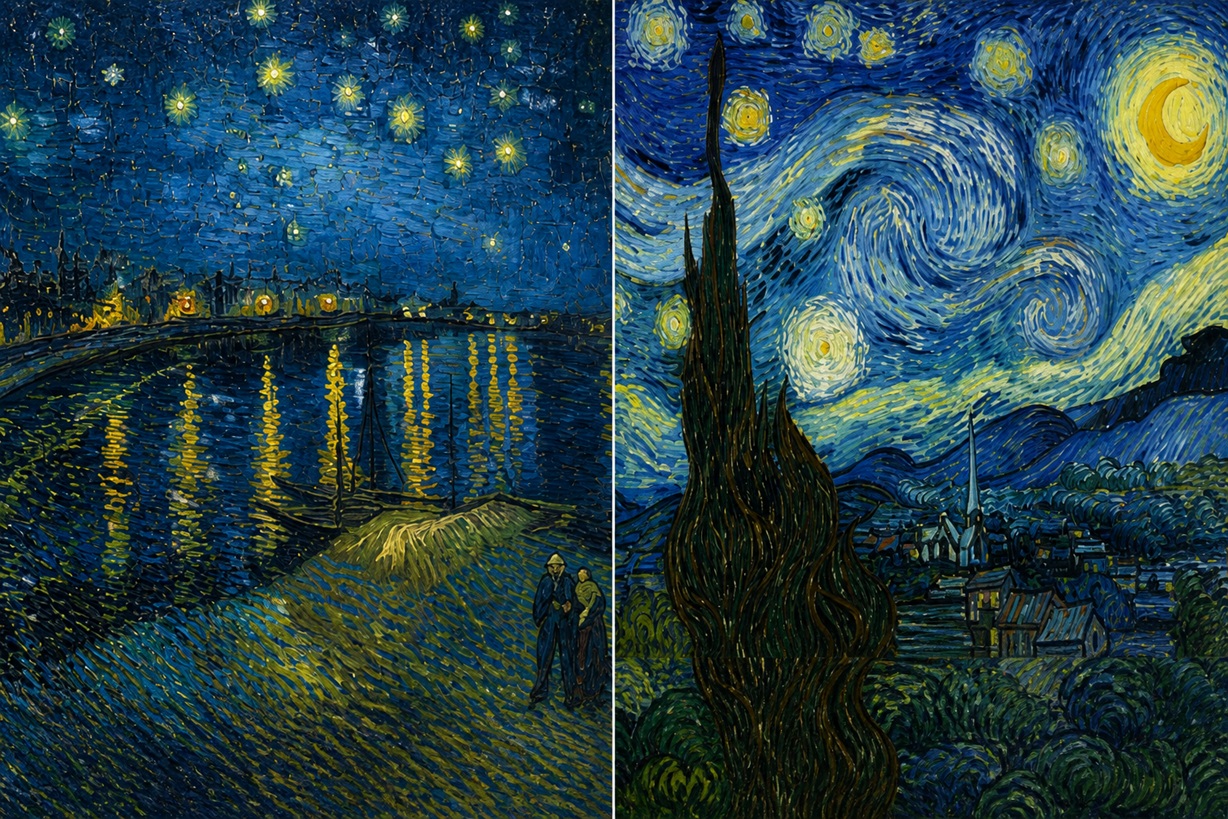
Many people don’t realize Van Gogh painted an earlier nighttime masterpiece in 1888 called Starry Night Over the Rhône.
This earlier version depicts shimmering reflections over the Rhône River and was the first time Van Gogh deeply explored nocturnal beauty.
While the 1889 The Starry Night became legendary, Van Gogh himself considered it overly abstract and less successful than his other works. Ironically, the painting he doubted became one of the most celebrated artworks in history.
4. Venus May Be Hidden in the Sky
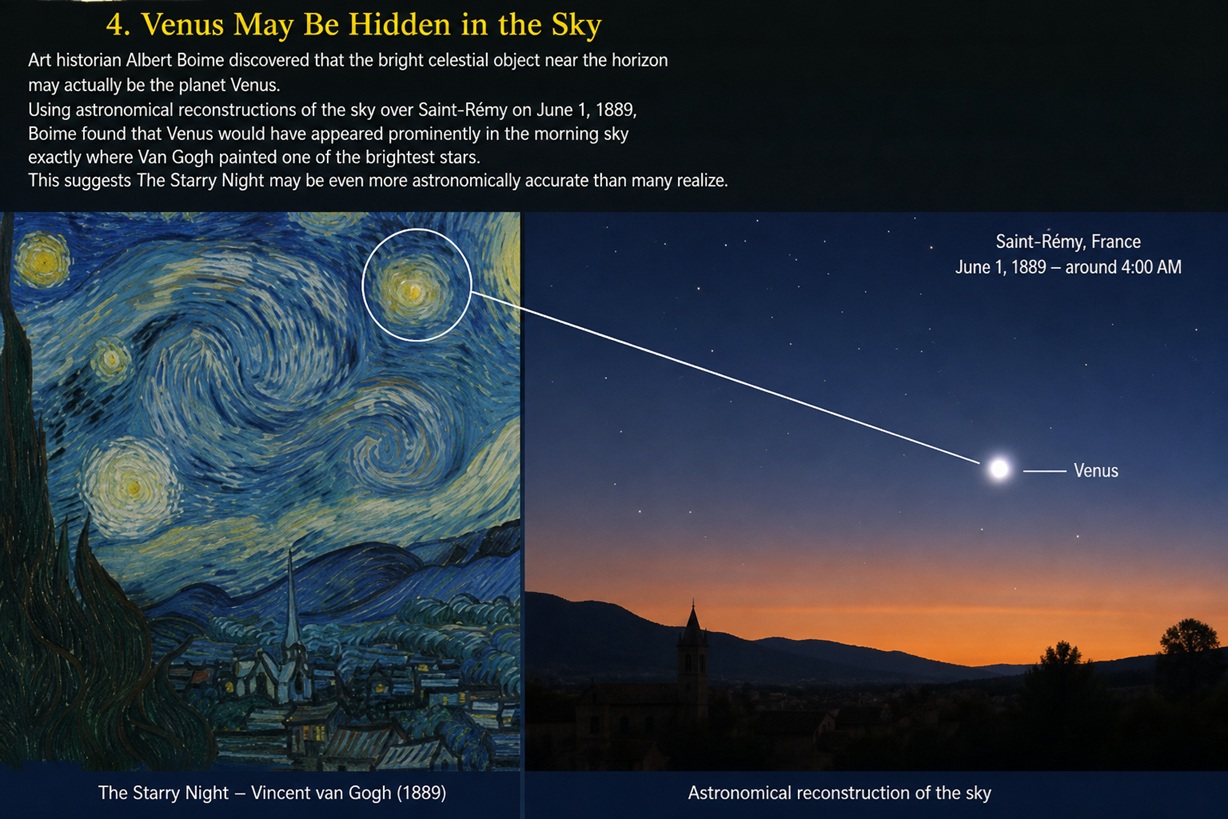
Art historian Albert Boime discovered that the bright celestial object near the horizon may actually be the planet Venus.
Using astronomical reconstructions of the sky over Saint-Rémy on June 1, 1889, Boime found that Venus would have appeared prominently in the morning sky exactly where Van Gogh painted one of the brightest stars.
This suggests The Starry Night may be even more astronomically accurate than many realize.
5. The Stars Appear to Twinkle Because of Science
One of the painting’s most mesmerizing features is how the stars seem to pulse and shimmer.
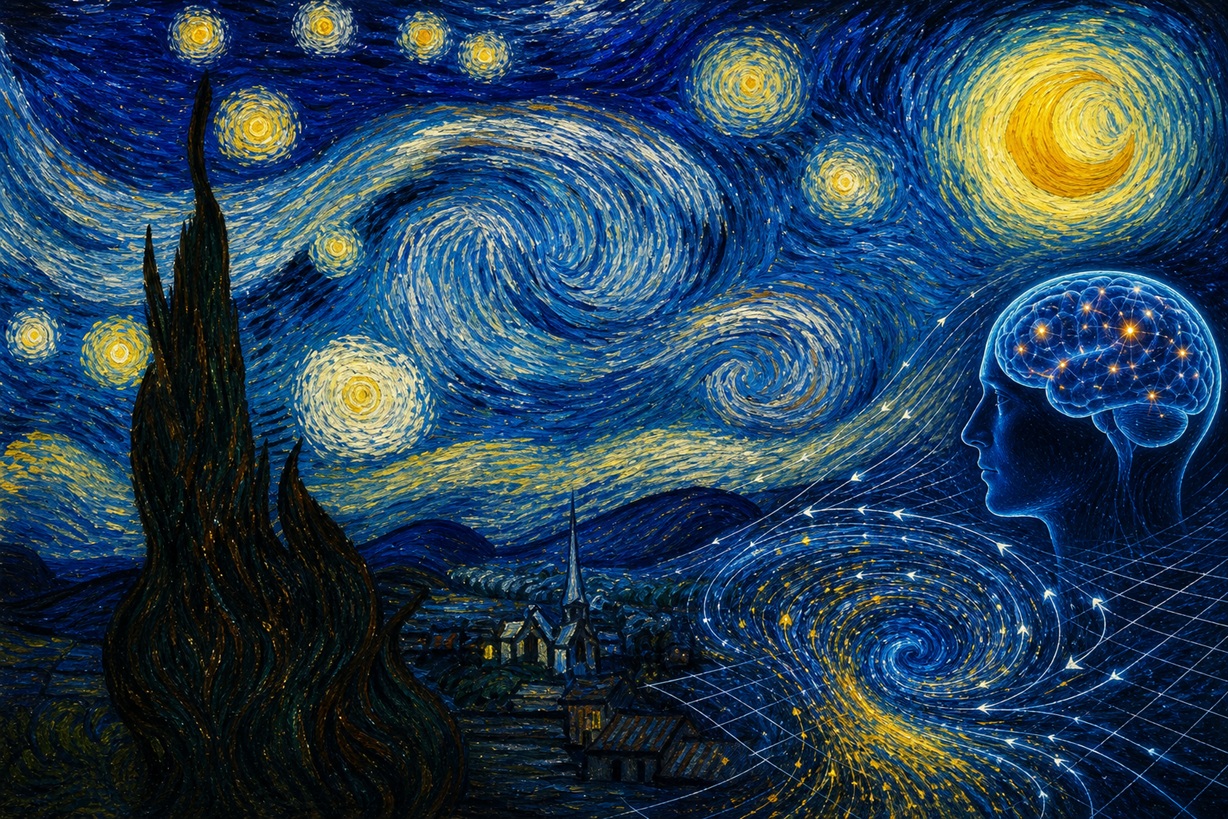
This effect comes from Van Gogh’s bold use of contrasting colors and luminance. His brushwork triggers the brain’s visual processing in ways that create the illusion of movement and flickering light.
Modern scientists have even studied the swirling patterns in The Starry Night and found they remarkably resemble mathematical models of turbulence in fluid dynamics.
In other words, Van Gogh may have intuitively captured patterns of natural chaos decades before science formally explained them.
Why The Starry Night Still Captivates Us
More than a painting, The Starry Night is a powerful blend of art, emotion, astronomy, and psychology. It reflects Van Gogh’s personal suffering while simultaneously connecting viewers to something universal: wonder, mortality, and the infinite beauty of the universe.
That emotional depth is why this masterpiece continues to resonate with audiences across generations.