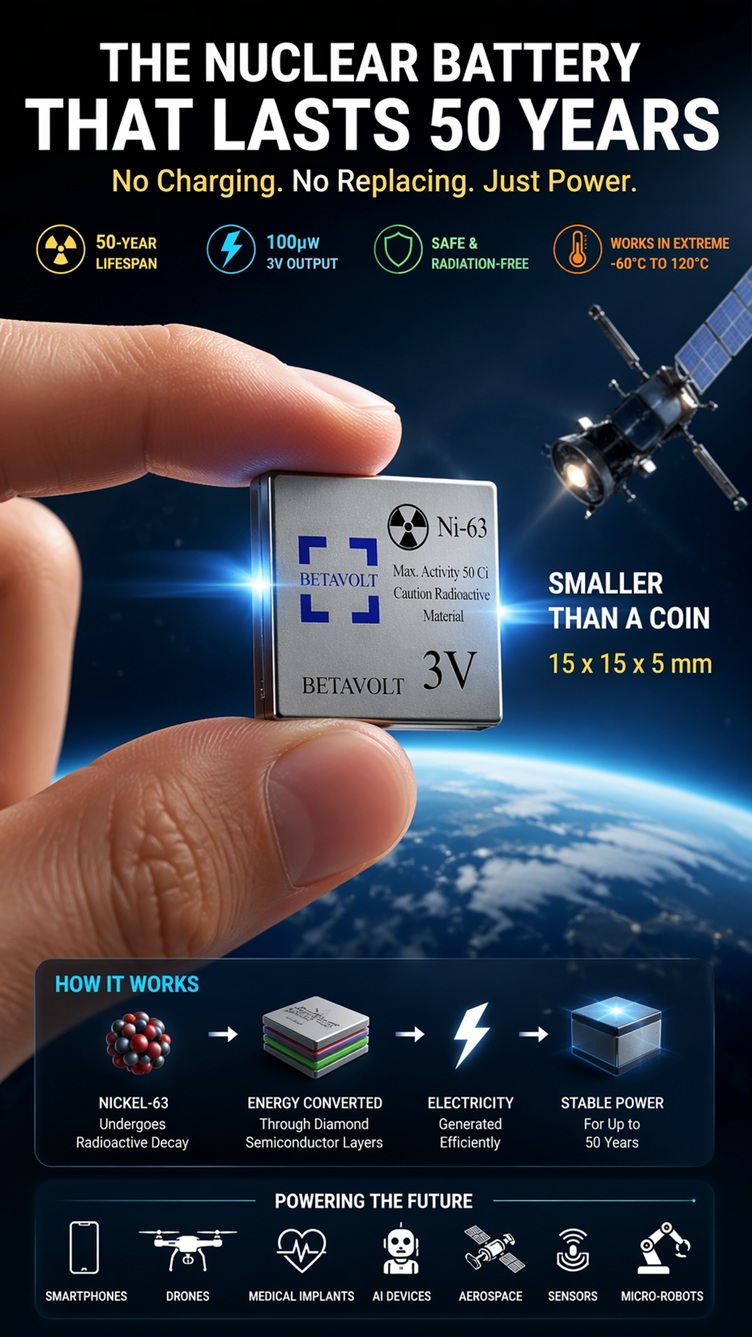
A Chinese startup, Betavolt Technology, claims it has developed an ultra-compact nuclear battery smaller than a coin—capable of powering devices for up to 50 years without recharging.
A Chinese startup, Betavolt Technology, claims it has developed an ultra-compact nuclear battery smaller than a coin—capable of powering devices for up to 50 years without recharging.
The prototype measures just 15 × 15 × 5 mm, yet it can generate 100 microwatts of power at 3 volts by harnessing energy from the radioactive decay of 63 nuclear isotopes. The company says this breakthrough could fundamentally change how we power everyday electronics.
A Potentially “Infinite” Energy Source
According to reports from TechRadar, the battery is currently in the testing phase, with plans for mass production targeting consumer electronics such as smartphones and drones. Betavolt also sees applications in aerospace systems, artificial intelligence devices, medical implants, sensors, and micro-robots.
The concept isn’t entirely new—similar nuclear battery technology has long been used in pacemakers and satellites—but Betavolt aims to dramatically shrink the size while maintaining durability and safety.
Looking ahead, the company is working toward a more powerful 1-watt version, which it hopes to bring to market in the near future. If successful, this could eliminate the need for chargers altogether, enabling devices to run continuously for decades without performance degradation.
How Does It Work?
The battery uses Nickel-63 as its energy source. As the isotope undergoes radioactive decay, it releases energy that is converted into electricity through a diamond semiconductor layer.
Engineers developed an ultra-thin single-crystal diamond semiconductor—just 10 microns thick—and sandwiched a 2-micron layer of Nickel-63 between two such semiconductor layers. This setup allows the energy from radioactive decay to be efficiently converted into a stable electrical current.
The result is a lightweight, high-energy-density power source that can operate in extreme conditions ranging from -60°C to 120°C.
Is It Safe?
Betavolt emphasizes that the battery is safe for use, stating that it emits no external radiation. Similar technologies have already been safely used in medical devices implanted in the human body, such as pacemakers and cochlear implants.
Once the radioactive material fully decays, the Nickel-63 transforms into stable copper, which is non-radioactive and poses no threat to human health or the environment.
If the technology proves viable at scale, it could mark a major shift in how we design and use electronic devices—moving from daily charging habits to truly long-lasting, maintenance-free power systems.