An Overview of British History
An Overview of British History
Prehistoric Britain and the First Settlers (c. 4000 BCE – 1500 BCE)
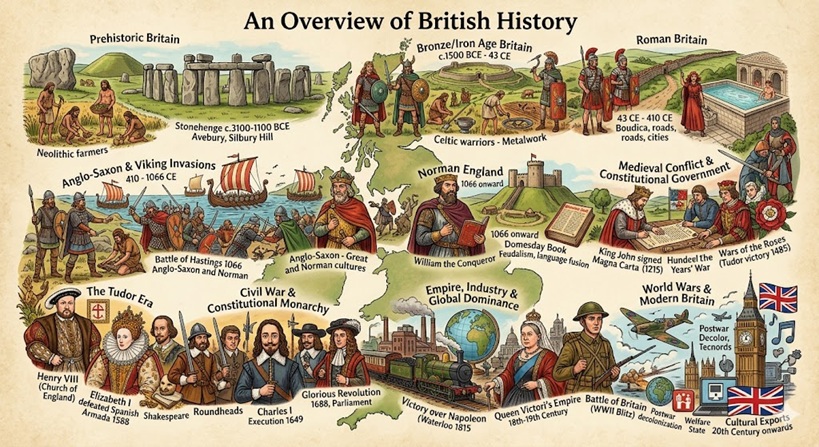
Around 4000 BCE, while much of the world was still in the earliest stages of human civilization, the land now known as Britain was already home to Neolithic communities. At that time, Britain was not yet an island but was connected to mainland Europe by a narrow land bridge. Rising sea levels eventually submerged this connection, isolating Britain and shaping a society that developed with relative independence from continental conflicts.
These early Britons, armed only with stone tools, left behind remarkable monuments that still inspire awe today. Among their greatest achievements were large burial mounds, ceremonial stone circles, and sophisticated stone structures. Two of the most famous prehistoric sites are Avebury and Stonehenge.
Avebury was an extraordinary ceremonial complex consisting of multiple interconnected structures. Massive standing stones were arranged in circles and avenues, linking Avebury with nearby sites such as The Sanctuary, while Silbury Hill—the largest prehistoric artificial mound in Europe—stood nearby as another testament to their engineering ability.
Stonehenge remains perhaps the most iconic symbol of ancient Britain. Built beginning around 3100 BCE and used for nearly two thousand years, it continues to be one of history’s greatest mysteries. Scholars have debated whether it served as a religious temple, an astronomical observatory, or a ceremonial gathering place. Regardless of its original purpose, Stonehenge demonstrates astonishing architectural skill. Some stones weighing up to 50 tons were transported over 240 miles from the Welsh mountains, and they were precisely fitted together using mortise-and-tenon joints—all without metal tools.
By around 1100 BCE, Stonehenge gradually fell out of use, and over centuries parts of it were dismantled by local populations for building materials. It was not until 1918 that the British government formally recognized its immense historical significance and placed it under preservation.
From the Bronze Age to the Roman Invasion (1500 BCE – 43 CE)
By 1500 BCE, Britain’s inhabitants had entered a more advanced era. Stone circles and burial monuments were no longer central to their culture. Instead, people developed farming communities, established permanent fields, and used increasingly sophisticated metal tools, eventually progressing to iron technology.
Trade with continental Europe expanded, with Britain exporting tin, gold, silver, and slaves in exchange for pottery, luxury goods, and coinage. Society became increasingly organized, with hill forts protecting tribal communities.
Despite these developments, Britain remained politically fragmented, divided among various Celtic tribes with no unified national power. This lack of centralization would later make the island vulnerable to outside conquest.
Roman Britain: The First Great Cultural Transformation (43 CE – 410 CE)
The Roman Empire, already dominant across much of Europe, first attempted to invade Britain under Julius Caesar in 55 BCE, though his campaigns failed to establish lasting control. Nearly a century later, in 43 CE, Emperor Claudius launched a full-scale invasion with approximately 40,000 troops.
Roman military superiority quickly overwhelmed Britain’s tribal societies, despite fierce resistance from Celtic leaders such as Boudica of the Iceni tribe. By 60 CE, much of Britain was firmly under Roman control.
Roman occupation transformed Britain dramatically:
Extensive road systems connected major settlements.
Fortifications such as Hadrian’s Wall (built in 122 CE) protected the empire’s northern frontier.
Roman towns introduced urban planning, baths, villas, and administrative governance.
Latin language, Roman law, and Christianity gradually influenced local society.
Roman Britain became a significant province, but by the early 5th century, internal crises and barbarian invasions forced Rome to withdraw its legions. In 410 CE, Roman authority ended permanently, leaving Britain vulnerable once more.
Anglo-Saxon England and Viking Invasions (410 – 1066)
After the Roman withdrawal, Britain entered a turbulent period. Germanic tribes—primarily the Angles, Saxons, and Jutes—were initially invited as mercenaries to defend against northern raiders. Instead, they gradually settled and conquered much of the land.
The native Celtic population was pushed westward into Wales, Cornwall, and Scotland, while Anglo-Saxon kingdoms emerged across England. Over time, seven major kingdoms formed, often competing with one another.
Beginning in the late 8th century, Viking raids from Scandinavia introduced another era of conflict. Viking forces eventually conquered large portions of England.
King Alfred the Great of Wessex became one of England’s defining rulers by successfully resisting Viking domination. His descendants later unified England under a single crown.
However, political instability persisted, and by 1066, England faced two simultaneous invasions:
Viking forces from Norway
Norman forces from France led by William, Duke of Normandy
After defeating the Vikings at Stamford Bridge, King Harold II was forced to march south and confront William’s army. Exhausted, Harold’s forces were defeated at the Battle of Hastings. Harold was killed, and William became King William I, forever altering English history.
Norman England (1066 onward)
The Norman Conquest was not simply a dynastic change—it fundamentally reshaped England’s political, social, and linguistic identity.
William the Conqueror introduced:
Feudalism
Castle-building on an unprecedented scale
The Domesday Book, an extensive land survey
Norman French as the language of the ruling elite
The fusion of Anglo-Saxon and Norman cultures laid the foundation for the English language and centralized monarchy.
Medieval Conflict and the Rise of Constitutional Government
Subsequent monarchs sought to expand power both domestically and abroad. However, tensions between kings and nobles frequently erupted.
A defining moment came in 1215 when King John was forced to sign the Magna Carta, establishing that even the monarch was subject to the law. This document became one of the foundational principles of constitutional government.
England also fought prolonged wars with France, most notably the Hundred Years’ War, while internal dynastic struggles culminated in the Wars of the Roses.
These conflicts ended with Henry Tudor’s victory at Bosworth Field in 1485, ushering in the Tudor dynasty.
The Tudor Era: Expansion, Reformation, and Renaissance
The Tudors oversaw one of England’s most transformative periods.
Henry VIII
Henry VIII is best remembered for breaking from the Roman Catholic Church after the Pope refused to annul his marriage. He established the Church of England, permanently altering Britain’s religious landscape.
Mary I
Mary attempted to restore Catholicism, earning the nickname “Bloody Mary” due to her persecution of Protestants.
Elizabeth I
Elizabeth I restored Protestantism and led England into a golden age characterized by:
Maritime exploration
Cultural flourishing
Colonial expansion
The defeat of the Spanish Armada in 1588
This period also saw the rise of literary giants such as William Shakespeare, Christopher Marlowe, and Francis Bacon.
Civil War, Republic, and Constitutional Monarchy (17th Century)
Conflicts between monarchy and Parliament intensified under the Stuart kings.
In the English Civil War:
Royalists supported King Charles I
Parliamentarians, led by Oliver Cromwell, opposed royal absolutism
Charles I was executed in 1649, and England briefly became a republic. Cromwell later established authoritarian rule, but after his death, the monarchy was restored.
In 1688, the Glorious Revolution replaced James II with William and Mary, firmly establishing constitutional monarchy and parliamentary supremacy.
Empire, Industry, and Global Dominance (18th – 19th Century)
Britain expanded into a global empire through military power, trade, and industrial innovation.
Key developments included:
The Industrial Revolution
Expansion into India, Canada, Africa, and beyond
Victory over Napoleon at Waterloo in 1815
Scientific and technological breakthroughs
Under Queen Victoria, Britain became the world’s leading imperial power, often described as “the empire on which the sun never sets.”
World Wars and Modern Britain (20th Century)
World War I
Britain played a central role in the Allied victory but suffered devastating human and economic losses.
Interwar Years
Economic hardship, labor unrest, and social reforms reshaped society.
World War II
Britain stood against Nazi Germany during its darkest hour, enduring the Blitz and eventually contributing significantly to Allied victory.
Britain Since 1945
Postwar Britain faced:
Economic reconstruction
Decolonization
The decline of empire
The rise of the welfare state
Although Britain’s territorial empire diminished, its global influence remained strong through language, culture, finance, science, and diplomacy.
Modern Britain has become known as much for its cultural exports—music, literature, film, and education—as for its political power.
Conclusion
Britain’s history is one of continual transformation:
From prehistoric monument builders
To Roman province
To Anglo-Saxon kingdom
To Norman state
To constitutional monarchy
To global empire
To modern democratic nation
Though the political empire has faded, British language, law, institutions, and culture continue to shape much of the modern world. The “sun” may no longer rule over British territory, but it still shines brightly through Britain’s enduring global legacy.