Exploring Aerogel: The “Frozen Smoke” Material of the Future
Exploring Aerogel: The “Frozen Smoke” Material of the Future
Humans have always pushed the limits of material science—searching for substances that are lighter, stronger, and more versatile. One of the most fascinating breakthroughs in this pursuit is aerogel, often nicknamed “frozen smoke” because of its ghostly, translucent appearance.
Despite looking impossibly fragile, aerogel is one of the most advanced materials ever created—and it could play a major role in shaping the future.
What Is Aerogel?
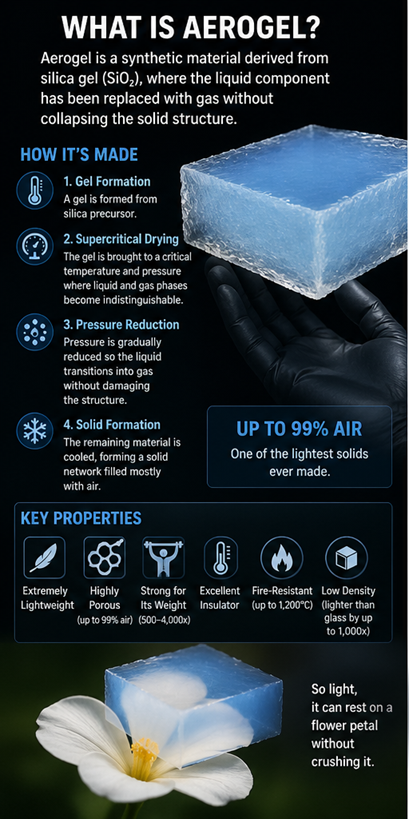
Aerogel is a synthetic material derived from silica gel (SiO₂), where the liquid component has been carefully removed and replaced with gas—without collapsing the solid structure.
The process is far from simple. Instead of letting the liquid evaporate naturally (which would destroy the structure), scientists use a technique called supercritical drying. This involves:
Bringing the gel to a critical temperature and pressure where liquid and gas phases become indistinguishable
Gradually reducing pressure so the liquid transitions into gas without damaging the structure
Cooling the remaining material to form a solid network filled mostly with air
The result is a solid that is up to 99% air.
A Brief History
Aerogel was first developed in the 1930s, but for decades it remained more of a scientific curiosity than a practical material.
Interest surged again in the late 20th century when NASA began using aerogel for space missions. In 1997, it was used to insulate the Sojourner rover on Mars, protecting it from extreme cold.
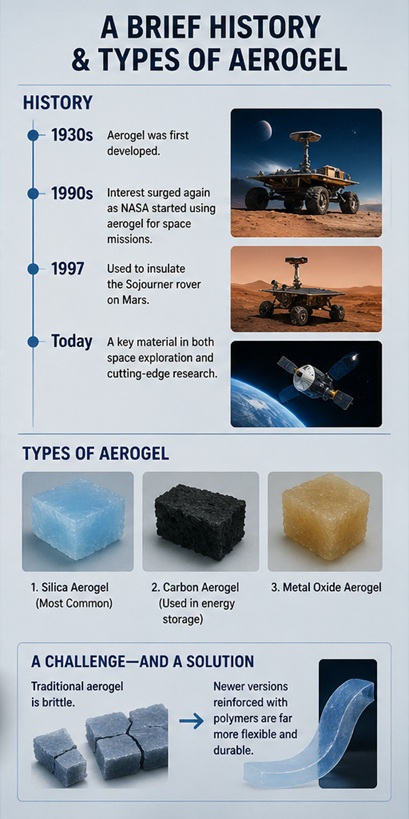
Since then, aerogel has become a key material in both space exploration and cutting-edge research.
Why Aerogel Is So Special
Aerogel’s properties sound almost unbelievable:
Extremely lightweight: One of the lightest solids ever made
Highly porous: Up to 99% of its volume is air
Strong for its weight: Can support 500–4,000 times its own weight
Excellent insulator: Blocks heat transfer through conduction, convection, and radiation
Fire-resistant and capable of withstanding temperatures up to 1,200°C
Low density: Lighter than glass by a factor of up to 1,000
In fact, a piece of aerogel is so light it can rest on a flower petal without crushing it.
Types of Aerogel
There are three main types in use today:
Silica aerogel (most common)
Carbon aerogel (used in energy storage)
Metal oxide aerogel
The main drawback? Traditional aerogel is brittle. However, newer versions reinforced with polymers are far more flexible and durable.
Real-World Applications
Aerogel isn’t just a lab curiosity—it’s already being used in real-world applications:
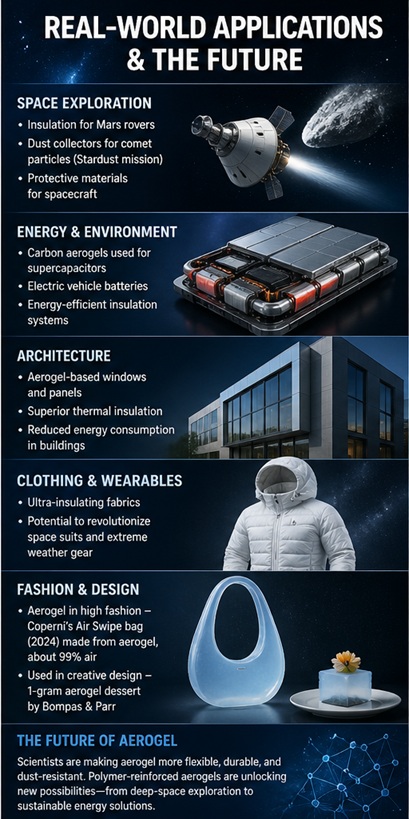
Space Exploration
NASA has used aerogel in multiple missions, including:
Insulation for Mars rovers
Dust collectors for comet particles (Stardust mission)
Protective materials for spacecraft
Energy & Environment
Carbon aerogels are being explored for:
Supercapacitors
Electric vehicle batteries
Energy-efficient insulation systems
Architecture
Aerogel-based windows and panels offer:
Superior thermal insulation
Reduced energy consumption in buildings
Clothing & Wearables
Aerogel can be used to create ultra-insulating fabrics, potentially revolutionizing:
Space suits
Extreme weather gea
Aerogel in Fashion and Design
Aerogel has even made its way into high fashion. The Air Swipe bag by Coperni debuted at Paris Fashion Week 2024 and quickly went viral.
Made from aerogel
Composed of about 99% air
Recognized as one of the lightest handbags ever created
In another creative experiment, the London-based studio Bompas & Parr used aerogel techniques to create an ultra-light dessert that weighed just one gram.
The Future of Aerogel
Scientists are continuing to improve aerogel by making it:
More flexible
Less brittle
More resistant to dust and environmental damage
Polymer-reinforced aerogels, in particular, are opening new possibilities—from deep-space exploration to sustainable energy solutions.
With its unique combination of lightness, strength, and insulation, aerogel is no longer just a scientific novelty—it’s a material that could redefine industries.